
It’s 2:17 a.m. You’re flat on your back, staring at the ceiling.
From across the room (or down the hall), your brand-new puppy is crying like you just stole their favorite toy and their best friend in one move. You’re exhausted. You’re second-guessing every life decision that led to this moment. And you’re desperately Googling “how to stop puppy crying at night” with one eye open.
First things first: you’re not doing anything wrong.
Puppy night crying is one of the most universal experiences in dog ownership. It’s normal, it’s temporary, and here’s the good news. It is completely solvable.
By the end of this post, you’ll know exactly why your puppy is crying, what to do about it tonight, and how to build a new puppy night routine that gets everyone sleeping peacefully within a few weeks.
Why Does My Puppy Cry at Night? (The Real Reasons)
Before you can fix the crying, you need to understand what’s actually driving it. Spoiler: it’s not because your puppy hates you.
They Just Left Their Mom and Littermates
Think about what your puppy’s life looked like one week ago. They were sleeping in a warm pile with their siblings, constantly surrounded by familiar smells and sounds. Then suddenly, they’re alone in a crate in a strange house in suburban Ohio.
That’s a massive transition. According to the American Kennel Club, puppies are highly social animals and rely on their litter for warmth, comfort, and security in their early weeks. The first few nights away from their littermates are genuinely disorienting for them.
The crying isn’t drama. It’s a real emotional response to a real change.
Your Puppy Hasn’t Learned Alone Time Yet
Independence is a skill. Your puppy doesn’t arrive knowing how to be alone peacefully. Puppy separation anxiety at night is extremely common and well-documented in young dogs, especially in the first two to four weeks in a new home.
According to research published on the ASPCA’s Pro resources, separation-related behaviors in dogs are among the most reported concerns by new pet owners in the United States. The good news is that independence can absolutely be built, with the right approach.
They May Actually Need Something
Sometimes the crying isn’t anxiety at all. It’s a very simple, practical need.
Very young puppies (especially 8 to 10 weeks old) physically cannot hold their bladder for more than three to four hours. If your pup is crying at 1 a.m. and they last went out at 10 p.m., there’s a decent chance they need a potty break, not a therapy session.
Before assuming it’s behavioral, always rule out the basics: hunger, thirst, and a full bladder.
The Environment Feels Wrong
Puppies are sensitive to their surroundings in ways we often underestimate. A crate that’s too big, a room that’s too cold, a space that’s too isolated, or ambient sounds that feel startling can all keep a puppy restless and vocal all night.
Small environmental tweaks often make a dramatic difference. We’ll get into the specifics in the solutions below.
| Reason for Crying | Key Signs to Look For |
|---|---|
| Separation from littermates | Consistent crying regardless of needs being met |
| Needs a potty break | Crying after 3-4 hours, circling or restlessness |
| Hunger or thirst | Crying shortly after crate time, pawing at crate door |
| Environment discomfort | Shivering, refusing to settle, crying spikes with sounds |
| Hasn’t learned alone time yet | Crying stops when you enter the room, restarts when you leave |
Should I Ignore Puppy Crying at Night or Comfort It?
This is the question that divides every new puppy forum thread on Reddit. And the answer is more nuanced than either extreme.
The “Just Ignore It” Myth
You’ve probably heard the classic advice: “Let them cry it out. They’ll figure it out eventually.” And while that works reasonably well with some older dogs, it can actually backfire with very young puppies.
Here’s why. A puppy under 10 weeks old is still developmentally in a sensitive socialization window. According to research, how a puppy experiences stress during early development can have lasting effects on their temperament and confidence.
Leaving a young, genuinely distressed puppy alone for extended periods night after night isn’t toughening them up. It can actually deepen anxiety and make the crying phase last longer.
The Smart Response Strategy
The goal isn’t to rush to the crate every time your puppy makes a peep. That does reinforce the habit. But there’s a middle ground that works far better than complete ignoring.
Here’s a simple decision framework for nighttime crying:
- Wait 2 to 3 minutes. Not every whimper needs a response. Sometimes puppies settle on their own within a few minutes.
- Check for a real need first. Is it potty time? Are they too cold? Is the water bowl empty?
- If needs are met, give brief, calm reassurance. A quiet word, a gentle pat, then walk away. No big production. No playtime.
- Repeat consistently. The message you’re teaching is: “You’re safe, I’m here, and bedtime means sleep.”
This isn’t coddling. It’s smart, intentional communication that puppies actually understand.
10 Solutions That Actually Stop Puppy Crying at Night
Okay. Here’s what you actually came for. These are ten real, actionable solutions grounded in dog behavior and tried by thousands of US pet owners.
1. Set Up the Perfect Crate Environment
The crate should feel like a cozy den, not a jail cell. A common mistake is buying a crate that’s too large “so the puppy has room to grow.” Puppies actually feel more secure in a snug space.
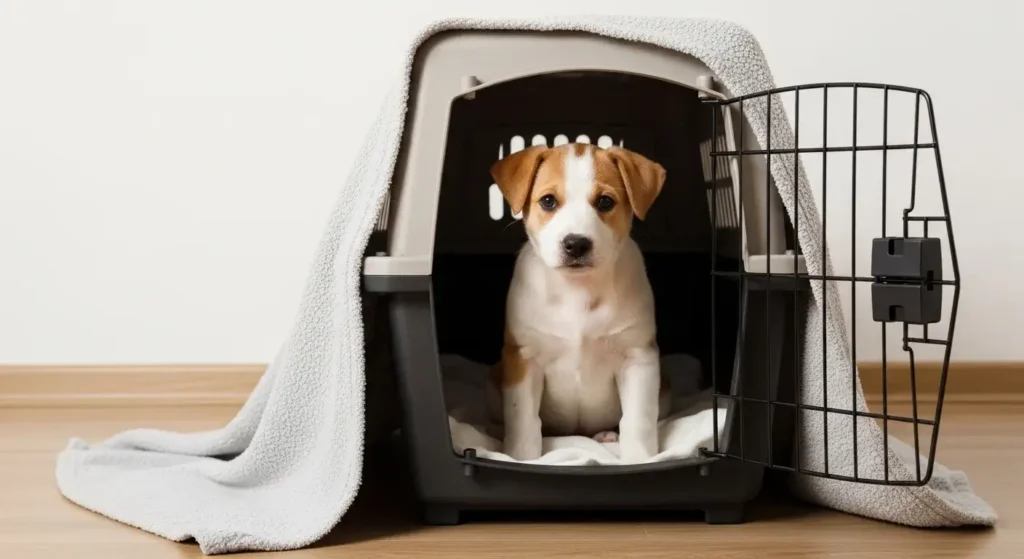
Cover three sides of the crate with a light blanket to create a den-like atmosphere. Add soft bedding, and place it somewhere with low foot traffic and minimal startling sounds. A properly set up crate is one of the most powerful tools in puppy sleep training. Check out our guide to Daily Dog Care Routine to see how crate time fits into the bigger picture.
Expert Tip: Choose a crate size that fits your puppy’s current body, not their adult size. Many crates come with dividers for exactly this reason. A snug space reduces anxiety and discourages accidents inside the crate.
2. Use a Heartbeat Toy or a Worn Comfort Object
This one sounds a little out there, but it genuinely works. Products like the Snuggle Puppy Behavioral Aid include a simulated heartbeat and warmth feature that mimics the feeling of sleeping next to a littermate. Many new puppy owners in the US swear by it for the first few weeks.
But here’s the version that costs exactly nothing: sleep with an old T-shirt for a night, then put it in the crate. Your scent is one of the most calming signals you can give a young dog. It works remarkably well.
3. Establish a Consistent Nighttime Routine
Dogs are creatures of habit. A predictable new puppy night routine signals to their brain that sleep time is coming and that everything is okay.
A simple routine that works well:
- 7:00 PM — Wind-down play (low-key, not high-energy)
- 8:30 PM — Final meal of the day
- 9:30 PM — Final potty trip outside
- 9:45 PM — Into the crate with a chew or Kong toy
- 10:00 PM — Lights dimmed, house quiets down
Routine reduces uncertainty, and reduced uncertainty reduces crying. It really is that straightforward.
4. Do a Final Potty Break Right Before Bed
This one move eliminates a huge percentage of middle-of-the-night crying episodes. Young puppies simply cannot hold their bladder for eight hours. According to guidelines from the AKC, puppies can typically hold it for roughly one hour per month of age, plus one.
So an eight-week-old puppy can hold it for approximately three hours max. Plan your nighttime schedule around that reality, not the one you wish were true.
5. Try White Noise or Calming Music
The average American home is full of random nighttime sounds: a car outside, the refrigerator kicking on, a neighbor’s dog. These sudden sounds can startle a light-sleeping puppy awake and trigger crying.
A simple box fan, a white noise machine, or a YouTube playlist of puppy sleep music can mask those sounds and create a consistently calm sonic environment. It’s a small move that makes a surprisingly big difference.
6. Place the Crate in Your Bedroom (At First)
This is the single fastest way to reduce first-night crying. Proximity to you dramatically calms a new puppy because they can hear your breathing, smell your presence, and feel like they haven’t been completely abandoned in a foreign land.
You don’t have to keep the crate in your bedroom forever. Start there for the first week or two, then gradually move it to your desired permanent location a few feet at a time over several days.
7. Never Use the Crate as Punishment
If your puppy associates the crate with being in trouble, they will cry every time they go in. It’s that simple.
Crate = safe zone, always. Never send your puppy to the crate as a consequence for bad behavior. The crate is their bedroom, not a timeout corner.
8. Build Positive Crate Associations During the Day
The secret to peaceful nights often hides in what you do during the day. If you only use the crate at bedtime, your puppy will associate it purely with isolation and sleep deprivation.
Instead, feed meals inside the crate with the door open. Toss high-value treats through the door randomly throughout the day. Let your puppy explore and nap in it voluntarily. By bedtime, the crate should feel like the best spot in the house, not a place to dread.
Expert Tip: Leave the crate door open all day and let your puppy choose to go in on their own. The first time they voluntarily nap in the crate is a milestone worth celebrating quietly (no big reaction, just let them enjoy the win).
9. Gradually Increase Alone Time (Desensitization)
One of the most overlooked tips to stop puppy crying at night in the crate is building up alone time during daylight hours first. Puppy separation anxiety at night gets worse when puppies have zero practice being alone.
Start with just 5 minutes in the crate while you’re in the next room. Build to 15 minutes. Then 30. Then an hour. By the time bedtime comes, the concept of “being in the crate while the humans are somewhere else” isn’t brand new and terrifying. It’s already familiar. And familiar is calm.
10. Stay Calm and Consistent Yourself
Puppies read energy the way we read facial expressions. If you’re tense, anxious, and making a big emotional production out of crate time every night, your puppy picks up on that.
Calm, matter-of-fact bedtime behavior tells your puppy that this is normal and safe. Walk them to the crate calmly. Give a quiet “goodnight.” Walk away with the energy of someone who is absolutely certain everything is fine. Because it is.
Understanding your dog’s emotional state matters here too. Take a look at our guide on how to Understand Dog Body Language to better read what your pup is actually communicating at night.
| Solution | Best For | Difficulty Level |
|---|---|---|
| Perfect crate environment | All puppies | Easy |
| Heartbeat toy or worn T-shirt | First nights, high-anxiety pups | Easy |
| Consistent nighttime routine | All puppies | Easy |
| Final potty break before bed | Young puppies under 4 months | Easy |
| White noise or calming music | Sound-sensitive puppies | Easy |
| Crate in bedroom (initially) | First-week puppies | Easy |
| Crate = positive zone only | All puppies | Medium |
| Daytime crate association building | Crate-resistant puppies | Medium |
| Gradual alone time practice | Anxious puppies | Medium |
| Calm, consistent owner energy | All puppies | Medium |
How Long Does a Puppy Cry at Night Before It Gets Better?
Here’s the honest answer: the first three to five nights are typically the hardest. After that, if you’re consistent, you will see measurable improvement.
What to Expect Week by Week
Week 1 — Expect broken sleep. Your puppy is processing a huge life change. Crying will likely be loudest and longest during this stretch. This is normal, not a sign that your approach is failing.
Week 2 — With a consistent routine in place, most puppies begin to settle faster. Crying episodes get shorter. Middle-of-the-night wake-ups may still happen, especially for very young pups who need a bathroom break.
Week 3 and beyond — The majority of puppies are sleeping through the night (with one possible potty trip for very young ones) by the three-week mark, provided the owner has been consistent with the routine.
According to Zoetis Pet Care, most healthy puppies can begin sleeping through the night between 16 and 20 weeks of age, depending on breed and individual temperament.
The biggest factor in that timeline is you. Inconsistency is the number-one reason puppies cry longer than necessary.
Pro Tips From Experienced Dog Owners (That Nobody Talks About)
These aren’t the tips you’ll find on every generic puppy blog. These come from the kind of dog owners who’ve been through it more than once and figured out what actually moves the needle.
The Sleep Shirt Trick — Don’t just grab any old shirt. Wear it for a full day, ideally including a workout. The stronger your scent on it, the more effective it is as a comfort object in the crate.
The Fake Yawn — It sounds ridiculous, but yawning is a calming signal in dog communication. Slow, deliberate yawning near your puppy before crate time can actually trigger relaxation. Dog behavior researchers have studied this phenomenon extensively, including work referenced in studies on canine stress signals published in Frontiers in Veterinary Science.
Wind Down 30 Minutes Early — Stop all play and interaction 30 minutes before crate time. An over-stimulated puppy does not fall asleep quickly. Transition from play to calm the same way you’d wind down a toddler.
Don’t Sneak Away — Some owners try to slip away while the puppy is distracted. This usually backfires. Puppies who notice you’ve disappeared without warning often panic harder than puppies who watched you calmly walk away.
Dim the Lights Early — Start lowering light levels in the house about 45 minutes before bedtime. Dogs respond to environmental light cues similarly to humans. A gradual dim signals the end of the day. Learn more about how your Calmest Dog Breeds handle nighttime routines differently and what that might mean for your own pup.
Track the Pattern — Keep a three-night log of when your puppy cries and for how long. If the total crying time is getting shorter each night, even slightly, you’re on the right track. Progress isn’t always obvious in the moment.
Common Mistakes That Make Puppy Crying Worse at Night
We’ve all made these. No judgment here.
Taking the puppy to your bed when they cry — This teaches them that crying is the password to get into the big bed. If that’s actually fine with you long-term, no problem. But if you want your dog sleeping independently, this habit is very hard to undo once it’s established.
Being inconsistent night to night — If you ignore the crying on Monday but rush in on Tuesday, your puppy doesn’t know what the rules are. Inconsistency extends the crying phase significantly.
Feeding too close to bedtime — A full belly means active digestion, which often means a potty need at 2 a.m. Give the last meal at least 90 minutes before crate time.
Buying a crate that’s too large — Extra space in the crate can actually feel more isolating and less secure to a young puppy. It can also lead to one end becoming a bathroom. Snug is better in the early weeks.
Making the bedtime goodbye emotional — Long, drawn-out goodnights with lots of baby talk and lingering hugs actually ramp up puppy anxiety. It signals “something big is happening.” Keep it short, calm, and casual.
If things ever go sideways and you feel like you’ve accidentally made your puppy feel bad during training, here’s our guide on how to Apologize to a Dog to help repair that trust.
Myths vs. Facts: What You’ve Probably Heard About Puppy Night Crying
| Myth | Fact |
|---|---|
| “Let them cry it out. They’ll learn eventually.” | Extended ignoring can worsen anxiety in young puppies. Smart, responsive settling consistently outperforms full ignoring. |
| “Comforting them will spoil them.” | Brief, calm reassurance during the adjustment period does not create long-term bad habits when done correctly. |
| “A really tired puppy will sleep through the night.” | Over-exercising a young puppy before bed can increase cortisol levels and actually make them more restless. |
| “Only anxious breeds have trouble sleeping.” | All puppies cry at night initially. It’s universal behavior, not a breed or personality flaw. |
| “You need expensive products to solve night crying.” | Consistency, routine, and a worn T-shirt with your scent outperform most gadgets. The basics almost always work. |
Conclusion: Hang In There. This Phase Won’t Last Forever.
Here’s the thing nobody tells you loudly enough when you bring home a puppy: the hard part is temporary, but the good part is permanent.
The four key things to take away from all of this:
- Understanding why your puppy cries makes the right solution obvious.
- Routine, environment, and your own calm energy are the three pillars that fix almost everything.
- Most puppies adjust meaningfully within one to three weeks when owners stay consistent.
- You are not alone in this. Every single dog owner has been exactly where you are right now.
The puppy crying at 2 a.m. tonight will be the same dog snoring on the couch next to you in a few weeks. You’ve got this. Stay consistent, trust the process, and get some sleep when you can.
Frequently Asked Questions
How do I stop my puppy from crying at night?
Start with a consistent nighttime routine, place the crate near your bed, add a comfort object with your scent, and do a final potty break right before sleep. Stay calm at bedtime. Most puppies improve noticeably within one to two weeks when the routine stays consistent every single night.
Should I ignore my puppy crying at night?
Not entirely, especially in the early weeks. First check for a real need like hunger, a potty trip, or discomfort. If all needs are met, give brief and calm reassurance, then leave without making it a big event. Completely ignoring a young, distressed puppy can deepen anxiety and extend the crying phase.
How long will my puppy cry at night?
The first three to five nights are usually the hardest. With a consistent routine, most puppies cry noticeably less by the second week. The majority of pups are sleeping through the night, or close to it, within two to three weeks of arriving home.
Why does my puppy cry in the crate at night?
Crate crying usually comes from being separated from their littermates for the first time, not yet having built positive associations with the crate, or a genuine need like hunger or a bathroom trip. It’s normal and fixable with consistent crate training and a steady bedtime routine.
What should I do on my puppy’s first night at home?
Keep the environment calm and low-stimulation. Set up a cozy crate near your bed, place a worn T-shirt inside, do a final potty break, and keep goodnight brief and casual. Expect some crying on night one. It’s completely normal and does not mean anything is wrong.
Is it okay to let my puppy sleep in my bed to stop the crying?
It will stop the crying immediately. But it also teaches your puppy that crying is how they earn access to the bed. If you want your dog to sleep independently long term, it’s worth working through crate training now, even though the first few nights are harder. The short-term discomfort pays off quickly.