You’re halfway through your evening walk, scrolling your phone, ready to head home. Your dog is frozen at a mailbox like it just found buried treasure.
You’re not the only dog owner facing this challenge.
For you, a walk is exercise. For your dog, it’s the local news, a text thread, and a sensory buffet all rolled into one. This article breaks down exactly what dogs notice on walks that we humans tend to miss completely.
By the end, you’ll understand your dog’s world a little better. And your next walk might feel a lot less like a chore and more like a shared adventure.
Ask any longtime dog owner in a US neighborhood and they’ll tell you the same thing. The dog who “won’t move” at the corner isn’t stubborn. That dog is simply busy.
A Walk Isn’t Just Exercise, It’s a Whole Different Experience for Your Dog
Here’s the mindset shift every dog owner needs. You walk to get somewhere or burn calories. Your dog walks to gather information.
Think of it like this: your walk is a workout. Your dog’s walk is a newspaper, a group chat, and a scavenger hunt combined.
Every fence post, patch of grass, and lamppost holds a story. Your dog reads that story with their nose before you even notice it’s there.
Once you understand how dogs experience walks this way, a lot of “stubborn” behavior suddenly makes sense.
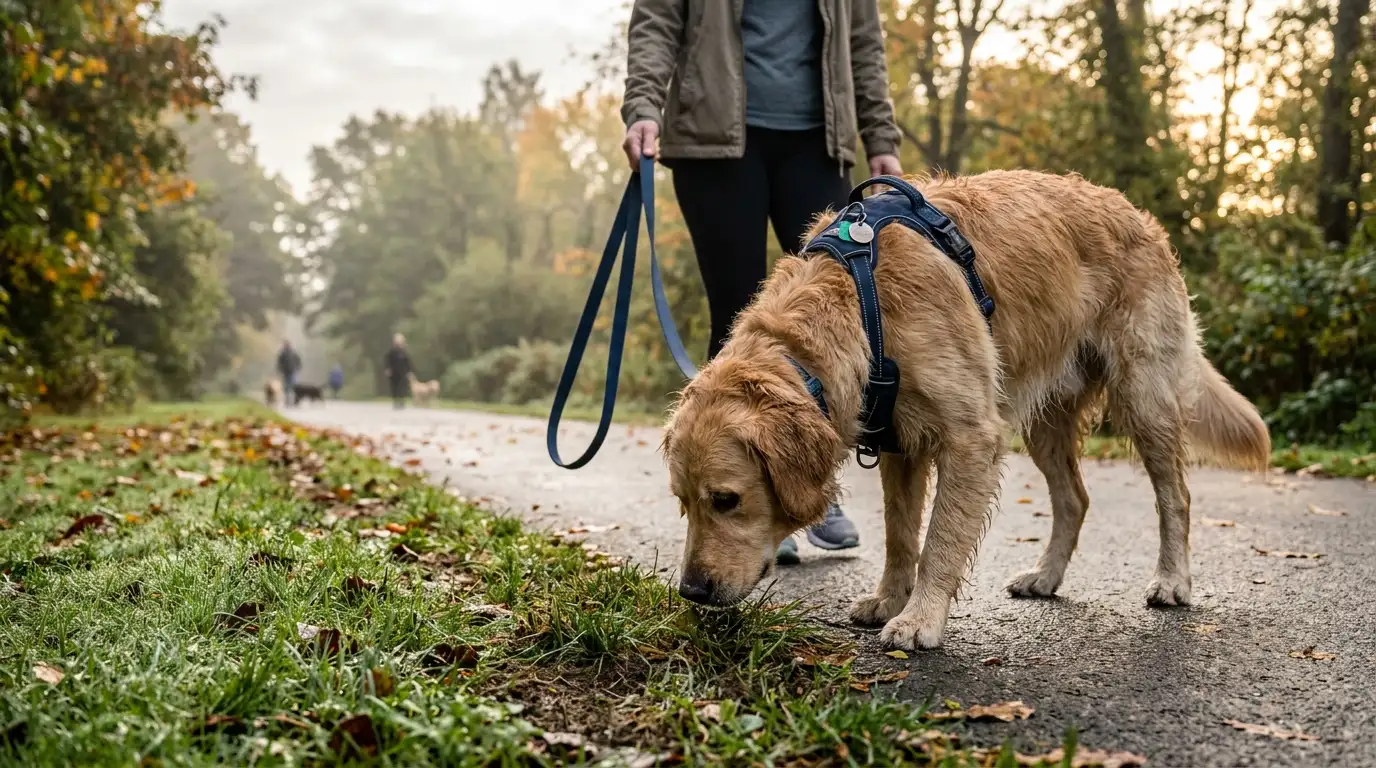
Take a typical golden retriever on a suburban street. To you, it’s just a stretch of sidewalk. To that dog, it’s a full inbox of new messages left overnight by every animal that passed through.
That’s why yanking the leash the second your dog slows down rarely works well. You’re essentially closing an email mid-sentence.
The Nose Knows: What Dogs Smell During Walks That Humans Never Will
Dogs live in a world built almost entirely on scent. Their nose isn’t just more sensitive than ours. It works on a completely different level.
Humans have about 5 to 6 million scent receptors. Dogs have somewhere between 100 million and 300 million, depending on the breed, according to the American Kennel Club. Bloodhounds sit at the top end of that range.
That difference isn’t small. It’s the reason your dog can smell a squirrel that crossed the yard hours ago.
Picture walking into a bakery. You smell “fresh bread.” Your dog smells the flour, the yeast, the butter, and the person who baked it, all as separate layers. That’s the kind of detail we’re talking about.
How Powerful is a Dog’s Nose, Really?
Numbers help put this in perspective. Here’s a simple side-by-side comparison.
| Feature | Humans | Dogs |
|---|---|---|
| Scent receptors | 5–6 million | 100–300 million |
| Brain space devoted to smell | About 5% | About 33% |
| Smell sensitivity | Baseline | Up to 10,000x more sensitive in some breeds |
| Breathing while sniffing | Inhale/exhale same path | Separate airflow paths for smelling and breathing |
Sources: American Kennel Club, Wikipedia summary of canine olfaction research
Dogs also breathe differently while sniffing. Air splits into two paths: one for breathing, one just for scent. That’s why dogs don’t need to “come up for air” between sniffs, unlike us.
The Hidden Smell Map of Your Neighborhood
Your dog isn’t randomly sniffing. They’re building a mental map of your entire block.
That fence post might tell them a new dog moved in. That patch of grass might say a rabbit passed through an hour ago.
Researchers studying canine olfaction note that dogs use smell to gather environmental information, recognize individuals, and make decisions in real time.
In other words, your neighborhood isn’t just a street to your dog. It’s a living, constantly updating scent map.
This is also why the same 15-minute loop rarely gets boring for your dog. Weather, foot traffic, and wildlife shift the scent map daily, even if the sidewalk looks identical to you.
If you’ve ever wondered why your dog drags you toward a specific yard every single day, this is usually why. Something in that yard changes often enough to keep pulling their attention back.
Why Do Dogs Stop and Sniff Everything?
Short answer: Sniffing isn’t a distraction. It’s information gathering, plain and simple.
When your dog buries their nose in the grass for what feels like forever, they’re not ignoring you. They’re reading a message left by another dog.
According to the American Kennel Club, dogs sniffing another dog’s scent can pick up clues about gender, age, and even health status. That’s a lot of detail packed into one quick sniff.
This is also why rushing your dog past every hydrant can feel frustrating for both of you. You want to keep moving. Your dog is trying to finish reading a paragraph.
Think about a busy dog park entrance on a Saturday morning. Dozens of dogs pass through in a single hour. For your dog, that gate is basically a group chat with a hundred unread messages.
No wonder some dogs need a solid minute just at the entrance before they’re ready to actually walk in.
Scent Marking: Your Dog’s Version of Social Media
Ever notice how dogs pee on top of where another dog just peed? That’s not random. That’s scent marking, and it works a lot like leaving a comment.
Your dog is essentially saying, “I was here too.” Other dogs read that message later and respond in kind.
Pet parents online often joke that fire hydrants are basically doggy Instagram. Honestly, that comparison isn’t far off.
Expert Tip: Instead of yanking your dog away from every sniff spot, try a “sniff and go” rule. Let them investigate for 10 to 15 seconds, then use a light leash cue to move forward. This keeps the walk moving without cutting off their information gathering completely.
Beyond Smell: Other Things Your Dog Notices That You Probably Miss
Smell gets most of the credit, but it’s not the whole story. Dogs pick up on sounds, movement, and subtle changes you’d never catch.
That includes a car parked in a new spot, a trash can moved two feet, or a dog barking three blocks away.
Owners often notice this without realizing what’s happening. Your dog stops walking, ears swivel, head tilts, and there’s nothing obvious around. That’s not nothing. That’s a whole sensory event happening just outside your awareness.
Sounds Your Dog Hears That You Don’t
Dogs hear a wider range of frequencies than we do, and at much softer volumes.
| Hearing Trait | Humans | Dogs |
|---|---|---|
| Frequency range | 20 to 20,000 Hz | Roughly 67 to 45,000 Hz |
| Best-sensitivity pitch | Around 2,000 Hz | Around 8,000 Hz |
| Detects sounds from | Standard distance | Up to 4x farther, per PAWS Chicago |
This is why your dog perks up at “nothing” on a quiet street. They likely heard a dog bark or a gate creak long before you could.
Reading Other Dogs Before You Even See Them
Ever notice your dog stiffen up before another dog even rounds the corner? That’s not a coincidence.
Dogs pick up on scent trails and faint sounds well before we register anything unusual. By the time you spot the other dog, your pup already knows it’s coming.
Understanding this can make walks less confusing. Your dog isn’t reacting to nothing. They’re reacting to something you simply can’t perceive yet.
This combination of canine body language and early detection is also why dogs seem to “predict” a visitor’s arrival. They aren’t guessing. They’re simply picking up on footsteps and scent minutes before you do.
How Dogs Explore the World During a Walk: A Sensory Timeline
Let’s walk through an actual walk, from your dog’s point of view.
- Stepping outside: Fresh air hits first. Your dog’s nose immediately starts scanning for anything new since yesterday.
- The first fence post: A quick sniff tells them who passed by, and roughly how long ago.
- A passing car: Dogs notice motion far more easily than fine detail, so a moving car grabs attention instantly.
- A familiar yard: Recognizing a neighbor’s scent can bring a relaxed, almost happy response.
- Something brand new: A dropped french fry, a strange leaf, an unfamiliar scent trail. This is peak canine curiosity in action.
- Heading home: Even the walk back offers new information, since scents shift with time and weather.
This timeline shows why a 20-minute walk can feel like a full day of “reading” for your dog.
Why This Matters: Mental Stimulation and Enrichment
Letting your dog sniff and explore isn’t just cute. It’s genuine mental exercise, and research backs this up.
In a widely cited study by Dr. Alexandra Horowitz and Charlotte Duranton, dogs who practiced nosework showed increased optimism on cognitive bias tests compared to dogs who only practiced heelwork.
Translation: letting your dog use their nose actually appears to improve their mood. That’s a big deal for anyone building a daily routine around their pet.
This concept, often called a “sniffari,” treats the walk as enrichment rather than just a bathroom break. A tired mind can be just as valuable as tired legs.
Plenty of trainers on Reddit’s r/Dogtraining echo this same idea in their own words. Owners often report calmer evenings at home after adding just one dedicated sniff walk to their week.
That lines up with what researchers found too. Dogs who got regular opportunities to use their nose showed better problem-solving persistence and more consistent self-control across different tasks, according to a survey of professional dog trainers.
If you’re building out a full Daily Dog Care Routine, sniff-focused walks deserve a regular spot on the schedule, not just an occasional treat.
Pro Tips: How to Let Your Dog Enjoy the Walk Their Way
Small changes make a big difference here. Try these:
- Build in sniff breaks. Pick two or three spots per walk where your dog can fully explore.
- Try a no-destination walk once a week. Let your dog lead and set the pace entirely.
- Use a longer leash in safe, low-traffic areas. More slack means more room to investigate.
- Rotate your walking routes. New streets mean new scents, which means more mental stimulation.
- Watch body language, not just the leash. A stiff posture or perked ears often means your dog noticed something before you did.
If your dog has limited vision, sniffing becomes even more important for navigation and confidence. Our guide on how to walk a blind dog safely covers specific techniques for these extra-sensory walks.
Big, energetic breeds benefit from this approach too. If you’re wondering how to walk a Golden Retriever without turning it into an Olympic sport, sniff breaks actually help burn mental energy and reduce leash pulling.
Common Mistakes Owners Make on Walks
Most of these mistakes come from good intentions, not bad ones.
- Rushing past every sniff spot. This cuts off your dog’s main way of understanding the world, and it usually leads to more pulling, not less.
- Treating walks purely as bathroom breaks. A five-minute lap around the block skips almost all the mental stimulation your dog actually needs.
- Ignoring body language cues. A frozen stance or raised hackles usually means something is happening nearby, even if you can’t see it yet.
- Always taking the same route. Same streets mean fewer new scents, which slowly turns an exciting walk into a routine chore for your dog.
- Scrolling on your phone the entire walk. You’ll miss the moments your dog reacts to something interesting, and you lose a real bonding opportunity.
- Skipping walks on busy days. Even a short, sniff-heavy walk beats no walk when your schedule is packed.
None of these make you a bad pet parent. They just leave a little enrichment on the table.
Myths vs. Facts About Dogs and Walks
| Myth | Fact |
|---|---|
| Sniffing means my dog is being disobedient | Sniffing is normal information gathering, not defiance |
| A tired dog is only a physically tired dog | Mental stimulation matters just as much as physical exercise |
| Dogs experience walks mostly through sight | Dogs rely on smell far more than sight, per AKC research |
| Longer walks always mean better walks | A shorter walk packed with sniff time can be more enriching than a fast, long one |
Conclusion
A walk is never just a walk for your dog. It’s a sensory event packed with scent trails, faint sounds, and small environmental changes you’ll probably never notice.
Once you understand what dogs notice on walks, patience gets a lot easier. That extra 30 seconds at the fence post isn’t wasted time. It’s your dog doing exactly what dogs do best.
Next time you head out, try slowing down for a minute. Let your dog take the lead, just once. You might be surprised at what they’re picking up on.
Walks don’t need to be rushed to count. Sometimes the most valuable ten minutes are the slowest ones, spent letting your dog do what dogs do best.
Frequently Asked Questions
Why do dogs sniff everything on a walk?
Dogs sniff to gather information about other animals, people, and changes in their environment. It’s their main way of understanding the world around them.
What can dogs smell that humans cannot?
Dogs can detect scent trails, individual scent markers from other animals, and odors in concentrations far too faint for the human nose to register.
Do dogs get bored walking the same route every day?
Repetition can reduce mental stimulation over time. Rotating routes gives dogs fresh scents and new environmental details to explore.
Is it okay to let my dog stop and sniff during walks?
Yes. Sniffing supports natural behavior and mental stimulation. Most trainers recommend building sniff breaks directly into your walking routine.
What does it mean when a dog suddenly stops and stares at nothing?
Your dog likely heard or smelled something you haven’t noticed yet. This is common, especially in quiet neighborhoods with a lot of wildlife activity.
How can I make walks more mentally stimulating for my dog?
Add sniff breaks, vary your route, and consider enrichment tools. A DIY snuffle mat without rubber is also a great way to extend that mental workout indoors on rainy days.