My dog Biscuit once ate an entire throw pillow in 20 minutes. Not because he was hungry. Because he was bored.
If your dog has ever turned your living room into a disaster zone on a rainy Tuesday, you already know what mental boredom looks like in a dog. And here’s the thing: the fix doesn’t have to cost $40 on Amazon.
A snuffle mat is one of the easiest, cheapest ways to keep your dog’s brain busy. But almost every tutorial out there assumes you’ve got a rubber mat sitting around. Most of us don’t.
So this guide shows you exactly how to make a DIY snuffle mat without a rubber mat, using stuff you probably already own. No special tools. No trips to the craft store. No rubber required.
What is a Snuffle Mat and Why Does Your Dog Go Crazy for One?
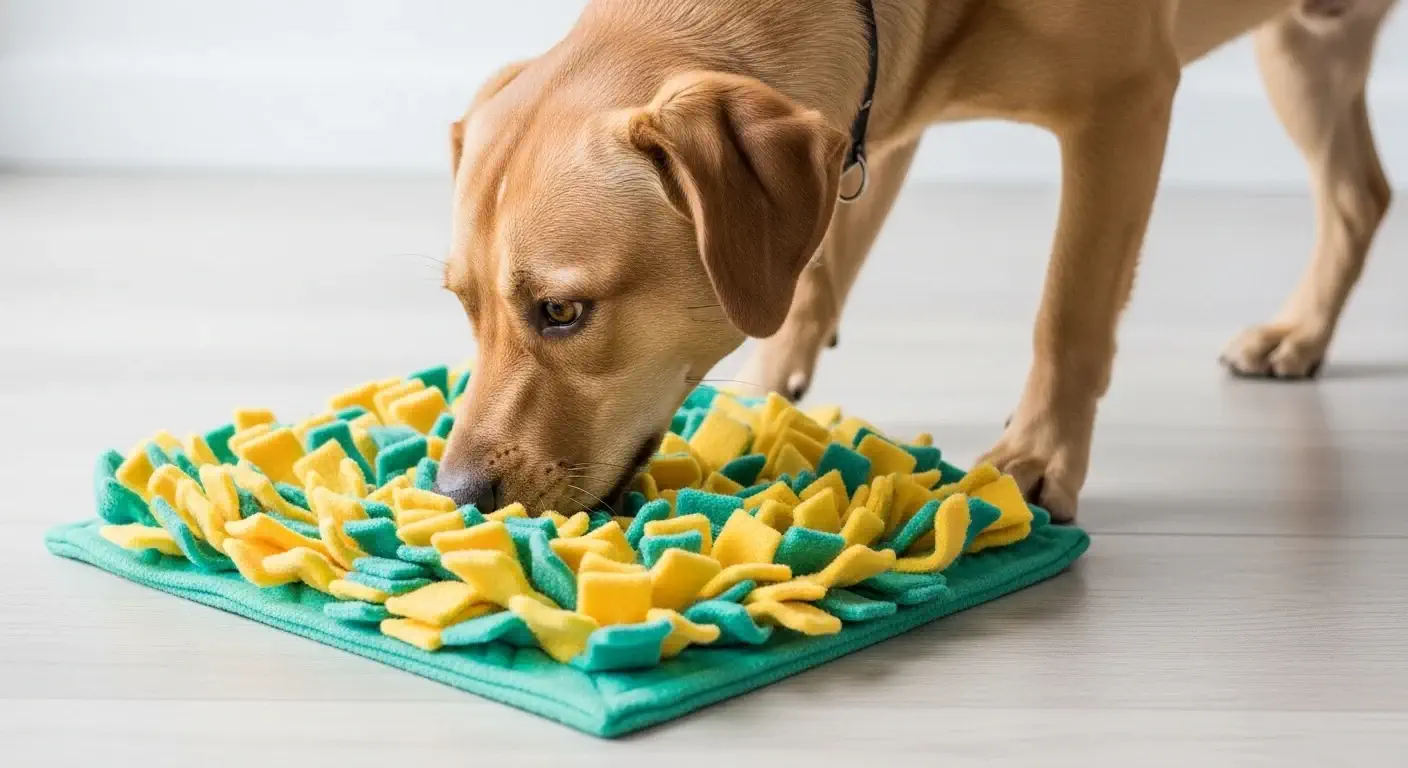
A snuffle mat is basically a foraging toy. It’s a textured mat with fabric strips where you hide kibble or treats. Your dog uses their nose to sniff out the food, which mimics the natural hunting behavior dogs would use in the wild.
Here’s why that matters.
According to the American Kennel Club, a dog’s sense of smell is estimated to be 10,000 to 100,000 times more powerful than a human’s. When your dog uses that superpower to sniff out food, it burns serious mental energy.
Think of it like this: 15 minutes on a snuffle mat can tire out your dog as much as a 30-minute walk. That’s a big deal on days when a walk just isn’t happening.
Snuffle mats work especially well for:
- High-energy dogs that never seem to settle
- Dogs with anxiety or nervous energy
- Senior dogs who need low-impact stimulation
- Puppies learning to focus
- Rainy days, post-surgery rest, or any indoor stretch
It’s one of the most recommended cheap dog enrichment ideas by trainers and behaviorists across the country because it works with your dog’s natural instincts instead of against them.
Why Skip the Rubber Mat Base Anyway?
Totally fair question.
The classic snuffle mat tutorial uses a rubber sink mat or a rubber anti-fatigue mat as the base. You poke fabric strips through the holes and knot them. Easy enough, if you happen to have one.
But a lot of people don’t. And honestly, even if you did, here are solid reasons to skip it:
- Rubber mats can get smelly over time and are harder to wash
- They’re not always chew-safe if your dog is a determined shredder
- Buying one just for a craft project adds unnecessary cost
- Some dogs are sensitive to rubber odors
The good news? A rubber base is not a requirement. It’s just what most people had available when the original DIY tutorials started circulating. Plenty of alternative materials work just as well, sometimes better.
What Can You Use Instead of a Rubber Mat?
This is where it gets fun.
You’ve got more options than you think. Here’s a quick comparison of the most popular alternatives so you can choose based on what you already have at home.
| Base Material | Cost Estimate | Washability | Durability | Best For |
|---|---|---|---|---|
| Plastic canvas sheet | $2-$5 | Easy | High | Beginners, structured look |
| Interlocking foam puzzle mat | $5-$10 | Easy | Medium-High | Families, soft surface |
| Burlap / jute fabric (doubled) | $3-$6 | Moderate | Medium | Eco-friendly crafters |
| Thick canvas (2-3 layers) | $4-$8 | Easy | Medium | Soft, washable option |
| Old rubber shelf liner | Free-$3 | Easy | High | Repurposing household items |
The top recommendation for most beginners is plastic canvas. It’s inexpensive, has pre-made holes perfect for fabric strips, holds its shape, and is widely available at Walmart, Hobby Lobby, or on Amazon for around $2 to $3 a sheet.
Expert Tip: If you’re going the plastic canvas route, buy two sheets and layer them together. This adds stiffness so the mat doesn’t curl up when your dog goes to town on it.
Materials You’ll Need (Keep It Simple)
Here’s the beauty of this project: you probably own most of this already.
For the base:
- 1-2 sheets of plastic canvas (or your chosen alternative from the table above)
For the fabric strips:
- Fleece fabric — old fleece blankets, thrift store finds, or fabric scraps work great
- Alternatively: old t-shirts, flannel shirts, or any non-fraying fabric
Tools:
- A good pair of scissors
- A ruler or measuring tape
- A marker (optional, for cutting guide lines)
- Binder clips or clothespins to keep things in place while you work
Why fleece? Fleece doesn’t fray when you cut it. That means no sewing, no fraying edges in your dog’s mouth, and easy washing. It’s the MVP of no-sew snuffle mat projects.
A typical snuffle mat uses about half a yard of fleece, which runs around $3 to $5 at a fabric store. You can often find fleece blankets at dollar stores or thrift shops for even less.
| What You’re Buying | Where to Get It | Estimated Cost |
|---|---|---|
| Plastic canvas sheets (x2) | Walmart, Hobby Lobby, Amazon | $4-$6 |
| Fleece fabric (0.5 yard) | Fabric store, thrift shop, old blanket | $0-$5 |
| Scissors | Already own | $0 |
| Ruler/marker | Already own | $0 |
| Total Project Cost | $4 to $11 |
Compare that to $25 to $50 for a store-bought snuffle mat. Yeah. You’re welcome.
How to Make a Snuffle Mat Without a Rubber Mat: Step-by-Step
Alright, let’s actually build this thing.
This method uses plastic canvas as the base. If you’re using a different base, the fabric-tying steps are identical. Just make sure your base material has holes or a grid structure to thread strips through.
Step 1: Prepare Your Base
Cut your plastic canvas to size. A good starting size for medium dogs is around 12 inches by 15 inches. For large dogs, go bigger: 15 by 18 inches. For small dogs, 10 by 12 inches works well.
If you’re layering two sheets, cut them the same size and hold them together with binder clips on the edges. They’ll act as one sturdy base once your fabric strips fill in.
Pro Tip: Smooth any sharp edges on the plastic canvas with scissors or a nail file. You don’t want rough plastic near your dog’s nose.
Step 2: Cut Your Fabric Strips
Cut your fleece into strips that are roughly 1 to 1.5 inches wide and 6 to 8 inches long.
Don’t stress about perfect measurements. A little variation in length actually adds texture and makes the mat more interesting for your dog.
Efficiency trick: Fold your fleece fabric several times before cutting. You can cut 8 to 10 strips at once this way, which saves a lot of time.
Aim for at least 150 to 200 strips for a medium-sized mat. That sounds like a lot, but it goes fast once you get into a rhythm.
Step 3: Tie the Strips Through the Base
This is the main event.
Here’s the tying technique:
- Fold one fabric strip in half so the two ends meet
- Push the folded (looped) end through one hole in the canvas from the bottom up
- Pull the two loose ends through that loop
- Pull firmly to tighten the knot
That’s it. Repeat until the mat is full.
Work in rows to keep yourself organized. Leave no hole empty, the denser the mat, the better the snuffle experience for your dog.
Expert Tip: Vary the direction of your strips as you tie them. Some strips going forward, some sideways, some at angles. This creates a more chaotic, layered texture that makes hiding treats much more effective.
Step 4: Fill the Entire Mat
Keep going until every hole has a strip.
When you’re done, the mat should look like a shaggy, fluffy mess. That’s exactly right. It should look like your dog’s happiest dream and your vacuum cleaner’s worst nightmare.
If you see any sparse patches, add more strips. The goal is that treats completely disappear when you bury them in there.
Step 5: Introduce It to Your Dog
Don’t just toss the mat down and walk away on the first try. Set your dog up for success.
Start easy: place kibble or small treats on top of the fabric strips so your dog can see and smell them immediately. Let your dog figure out what this thing is.
After a few sessions, start burying treats underneath the strips. Then bury them deeper. Keep increasing the challenge as your dog gets better at the game.
According to Psychology Today’s analysis of dog enrichment research, dogs show significantly lower stress behaviors when given regular nose work activities, including slower heart rates and reduced anxiety markers.
In other words, this little mat is doing more for your dog than you might realize.
Pro Tips to Level Up Your Snuffle Mat
These are the tips you won’t find in a basic tutorial.
1. Mix your fabrics. Use fleece, old denim, and cotton t-shirt strips together. Different textures make the snuffle experience richer and more engaging for your dog’s senses.
2. Freeze it. Spread wet food, peanut butter (xylitol-free), or soaked kibble into the strips and freeze the whole mat for two hours. Instant slow feeder upgrade.
3. Rotate it. Don’t use the snuffle mat every single meal. Rotate it with other dog enrichment toys DIY options every few days. Novelty keeps the excitement alive.
4. Supervise the first few sessions. Not because the mat is dangerous, but because you want to see how your dog interacts with it. Some dogs immediately start foraging. Others stare at you like you’ve lost your mind. Both reactions are normal.
5. Use the mat at mealtime. Instead of a bowl, put your dog’s entire meal in the snuffle mat a few times per week. According to veterinary behaviorists at the ASPCA, feeding enrichment like this reduces food-related anxiety and slows down fast eaters naturally.
Common Mistakes to Avoid (Learn From Other People’s Oops Moments)
Making this mat is easy, but here are the mistakes that trip people up on their first attempt.
Cutting strips too short. Strips under 5 inches tend to slip out of the knot, especially once the mat gets wet. Keep your strips at least 6 inches long.
Using fabric that frays. Regular cotton fabric frays when cut, leaving loose threads everywhere. Stick to fleece or use a pinking shears if you prefer cotton.
Leaving the mat too sparse. A sparse mat means treats fall straight through to the floor, defeating the whole purpose. Fill every hole.
Picking a base that’s too flimsy. A single thin sheet of canvas will buckle under an enthusiastic large dog. Layer two sheets or choose a sturdier base.
Going too hard too fast. Burying treats too deep on day one can frustrate your dog and make them give up. Build up difficulty gradually.
Skipping the wash. Food residue builds up fast. Wash the mat every 1 to 2 weeks in a mesh laundry bag on a gentle cold cycle. Air dry. Simple.
Snuffle Mat Variations Worth Trying Next
Once you’ve nailed the basic mat, here are three fun variations to try.
The Snuffle Ball: Tie fleece strips through the holes of a rubber ball or around a knotted rope ball. Great for dogs who like to carry their enrichment toy around.
The Muffin Tin Game: Place treats in the cups of a muffin tin, then cover each cup with a tennis ball. Your dog has to remove each ball to find the treat underneath. Easy to make, zero sewing, instant enrichment. This is a classic recommended on the r/dogtraining subreddit as one of the simplest DIY puzzles around.
The Snuffle Box: Take a cardboard box, fill it with crinkled newspaper, fabric scraps, and empty toilet rolls, then hide treats throughout. It’s basically a sensory treasure hunt. Dogs love it.
Conclusion: A Happy Dog is a Tired Dog
Your dog doesn’t need a $200 toy subscription box to be mentally fulfilled.
They need you to engage that incredible nose, give them a problem to solve, and let them do what evolution built them to do: sniff, search, and find.
This DIY snuffle mat without a rubber mat costs less than a fast food lunch, takes a couple of hours to make, and delivers days, weeks, even months of enrichment for your dog.
And the best part, you made it yourself. With your own hands. Biscuit would be proud.
Now go cut some fleece strips and let your dog have the best Tuesday of their life.
Frequently Asked Questions
Can I make a snuffle mat without any base at all?
Yes, you can. The most popular base-free method uses a knotted rope technique where fabric strips are tied together in a chain and looped back on themselves to form a self-supporting mat. It takes longer than the canvas method but requires zero additional materials. Great option if you want to use only fabric scraps you already own.
What’s the best fabric for a homemade snuffle mat?
Fleece is the clear winner. It doesn’t fray when cut, so there’s no sewing required. It’s soft on your dog’s nose, easy to find at thrift stores or in old blankets, and holds up well through multiple wash cycles. Avoid regular cotton unless you’re using pinking shears to minimize fraying.
How long does it take to make a DIY snuffle mat?
Most beginners finish in one to two hours. If you pre-cut all your strips first and then move straight to tying, you can cut that down significantly. Put on a podcast or your favorite show and it flies by. Experienced makers can knock out a mat in under 45 minutes.
Is a snuffle mat safe for all dogs?
For most dogs, yes. Always supervise the first few sessions to see how your dog interacts with the mat. If your dog tends to eat fabric rather than sniff it, choose thicker, tightly knotted strips and keep sessions short with close supervision. Replace any strips that show heavy wear.
How often should I let my dog use the snuffle mat?
Daily use is fine for most dogs. Keep sessions to 5 to 15 minutes and consider making it part of meal time rather than a separate snack time. Rotating it with other indoor activities for dogs every few days keeps the experience fresh and exciting.
What can I use instead of a rubber mat for a snuffle mat?
Your best options are plastic canvas sheets, interlocking foam puzzle mats, doubled burlap, thick layered canvas fabric, or repurposed rubber shelf liner. Plastic canvas is the most beginner-friendly because it already has a grid of holes, is inexpensive, and holds its shape well under an enthusiastic sniffer.