
Ever spot a dog at the park with a little white paintbrush dip on the end of its tail?
You’re not imagining things. That white tip is a real, documented trait.
It shows up in tons of breeds, from tiny lap dogs to giant mountain dogs.
I’ve owned Beagles, fostered hounds, and spent way too many Saturdays at dog parks studying tails (don’t judge me). This list comes from that hands-on experience, plus solid genetic research.
By the end of this post, you’ll know exactly what dog breeds have white tipped tails. You’ll also know why the marking exists in the first place.
Why Do Some Dogs Have White Tipped Tails?
Dogs get white tipped tails because of a coat color gene called MITF.
This gene controls where pigment cells travel during development. When they don’t reach the tail tip, you get white fur there.
Researchers at the UC Davis Veterinary Genetics Laboratory confirm that this MITF variant causes the piebald and white spotting patterns seen in dozens of breeds.
A separate genetics study published in PLOS ONE found the same MITF-linked pattern behind white markings in Beagles, Basenjis, and many other breeds.
So it’s not random. It’s baked into the dog’s DNA.
The “Flag Tail” Purpose in Hunting Breeds
Here’s the part most articles skip.
For scent hounds, that white tip isn’t just decoration. It’s a tool.
According to Orvis’s breed guide, Beagles almost always have a white tipped tail, and the tip was bred in specifically to help hunters spot the dog in tall grass.
Picture a hunter walking through brush. The dog’s nose is down, tracking a scent.
That white “flag” bobbing above the weeds is easy to follow. Smart, right?
This is why so many hunting and scent breeds share the trait. It’s function first, cute factor second.
Small Dog Breeds With White Tipped Tails
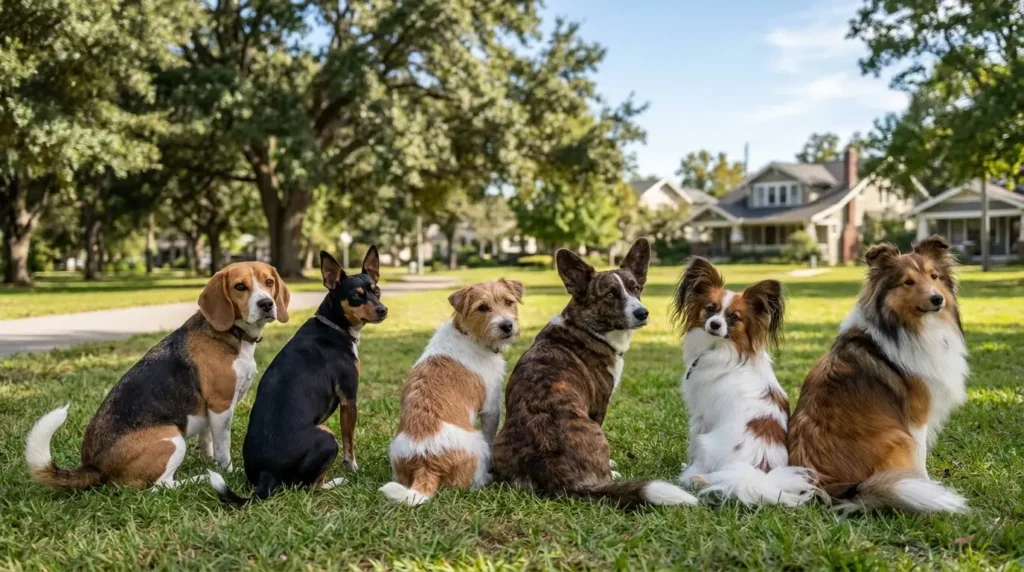
Small dogs get plenty of love for their big personalities. Turns out several of them rock a white tail tip too.
1. Beagle
Beagles almost always sport a white tipped tail. It’s practically a breed hallmark.
The National Beagle Club standard even calls for a white tip at the tail’s end, known as the “stern.”
If you’ve ever tried to call a Beagle back from a scent trail, you know that tail is often the last thing you see.
2. Rat Terrier
Rat Terriers are quick, clever, and often piebald.
Many have a crisp white tip on an otherwise dark or brindle tail.
They were bred as farm dogs, so that visible tail helped farmers keep track of them in tall grass too.
3. Jack Russell Terrier
Jack Russells are mostly white with patches of tan or black.
Their tails frequently end in a solid white section, making them easy to spot mid-chase.
If you own one, you already know they’re never standing still long enough for a slow look anyway.
4. Cardigan Welsh Corgi
Unlike its cousin the Pembroke, the Cardigan Corgi keeps its long tail.
Many Cardigans show a white tip at the end, especially in blue merle or brindle coats.
As a herding breed, that visible tail probably helped shepherds track them across a field.
5. Papillon
Papillons are known for those butterfly-shaped ears. Their plumed tails often finish in white too.
The tail curls forward over the back, so that white tip becomes a signature flourish.
6. Shetland Sheepdog (Smaller End)
Shelties sit right on the line between small and medium, depending on the dog.
Many have a white tail tip as part of their classic sable-and-white or tri-color coat.
This herding breed relies on clear visual signals, and a bright tail tip fits right in.
Medium Dog Breeds With White Tipped Tails
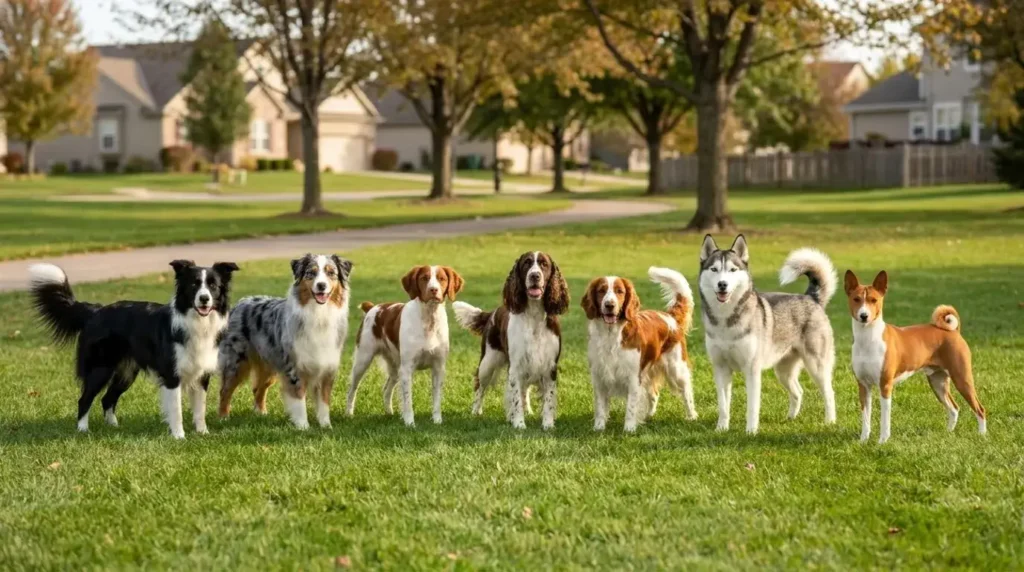
Medium dogs cover a huge range of jobs, from herding sheep to flushing birds. The white tail tip shows up across all of them.
7. Border Collie
Border Collies are famous for their intense stare and even more intense work ethic.
Many have a white tipped tail as part of their black-and-white pattern.
Herders wanted visibility across open pastures, so this trait likely stuck around for practical reasons.
8. Australian Shepherd
Aussies come in a rainbow of merle patterns, and a white tail tip is common.
Fun fact: many Aussies are actually born with naturally bobbed tails, so not every dog shows the full marking.
9. Brittany Spaniel
Brittanys are classic upland bird dogs. A bright white tail tip helps hunters track them through cover.
This is a textbook example of the flag tail doing its job in the field.
10. English Springer Spaniel
Springers flush birds for a living, and their liver-and-white or black-and-white coats often end in a crisp white tip.
Their whole look, honestly, seems designed for visibility in brush.
11. Welsh Springer Spaniel
Slightly less common than its English cousin, the Welsh Springer still often shows white tail markings.
Their red-and-white coat naturally lends itself to a lighter tail tip.
12. Siberian Husky
Huskies come in tons of color combinations. A white tipped tail is a frequent bonus feature, especially on agouti or black-and-white dogs.
If you’ve got a Husky, you already know that tail curls up over the back like a built-in scarf.
Huskies with striking blue eyes get all the attention online, so if you’re naming one, our list of blue eyed dog names might help.
13. Basenji
Basenjis are famous for not barking (they yodel instead, which is somehow funnier).
Their tightly curled tail almost always ends in a white tip, part of the classic Irish spotting pattern common in the breed.
Large Dog Breeds With White Tipped Tails
Big dogs, big personalities, and yep, some pretty striking tail markings too.
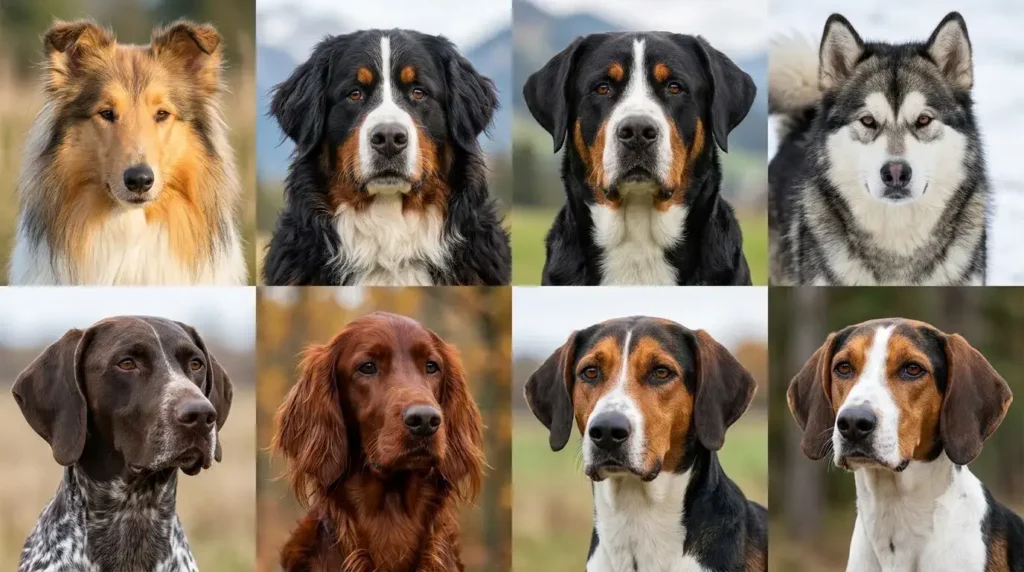
14. Collie (Rough and Smooth)
Think Lassie. That flowing tail almost always ends in white.
Collies were bred for herding, and this marking has stuck around through generations of show and working lines.
15. Bernese Mountain Dog
Berners are tri-color giants with a soft spot in every dog owner’s heart.
Many have a white tail tip as part of the classic Swiss mountain dog marking pattern.
16. Greater Swiss Mountain Dog
The Swissy shares that same tri-color pattern as the Bernese, often including a white-tipped tail.
These dogs were bred for farm work, so a visible tail made sense in barns and fields.
17. Alaskan Malamute
Malamutes are built for sled work in snowy terrain.
A white tail tip isn’t universal here, but it shows up often enough in their typical gray-and-white or black-and-white coats.
18. German Shorthaired Pointer
GSPs are ticked all over, and some individuals show a lighter or white tail tip, especially on liver-and-white dogs.
As a pointing breed, visibility in the field was always part of the plan.
19. Irish Setter
Not every Irish Setter has it, but some show a small white marking at the tail tip, especially dogs with a bit of white trim elsewhere.
It’s less common here than in some other sporting breeds, which makes it a fun one to spot.
20. English Foxhound
Foxhounds run in packs, chasing scent for miles.
A white tail tip helps hunters and fellow pack members track a dog through dense cover, similar to the Beagle’s setup.
21. Treeing Walker Coonhound
This American hound breed often shows a bold white tail tip against a tricolor coat.
Coonhounds work at night, so that visible flag tail is genuinely useful, not just a nice look.
Quick Reference Table: All 21 Breeds At a Glance
Here’s a scannable cheat sheet if you’re trying to identify a dog fast.
| Breed | Size | Original Job | Fun Fact |
|---|---|---|---|
| Beagle | Small | Scent hunting | White tip is a near-guaranteed breed trait |
| Rat Terrier | Small | Farm/vermin control | Bred for visibility in tall grass |
| Jack Russell Terrier | Small | Fox hunting | Mostly white body plus tail tip |
| Cardigan Welsh Corgi | Small | Herding | Keeps its long tail, unlike Pembrokes |
| Papillon | Small | Companion | Plumed tail curls forward |
| Shetland Sheepdog | Small/Medium | Herding | Sable, tri, or blue merle coats |
| Border Collie | Medium | Herding | Famous stare, famous focus |
| Australian Shepherd | Medium | Herding | Sometimes born with a bobbed tail |
| Brittany Spaniel | Medium | Bird hunting | Classic upland field dog |
| English Springer Spaniel | Medium | Bird flushing | Liver-and-white or black-and-white |
| Welsh Springer Spaniel | Medium | Bird flushing | Red-and-white coat |
| Siberian Husky | Medium | Sled pulling | Tail curls over the back |
| Basenji | Medium | Hunting | Doesn’t bark, yodels instead |
| Collie | Large | Herding | The “Lassie” breed |
| Bernese Mountain Dog | Large | Farm work | Classic Swiss tri-color |
| Greater Swiss Mountain Dog | Large | Draft/farm work | Berner’s bigger cousin |
| Alaskan Malamute | Large | Sledding | Built for snow and endurance |
| German Shorthaired Pointer | Large | Pointing | Ticked coat, athletic build |
| Irish Setter | Large | Bird hunting | Trait is less consistent here |
| English Foxhound | Large | Pack hunting | Runs for miles chasing scent |
| Treeing Walker Coonhound | Large | Night hunting | Bold tricolor with white flag tail |
Myths vs Facts About White Tipped Tails
Let’s clear up a few things people get wrong.
Myth: A white tail tip means your dog is part Border Collie.
Fact: This trait shows up in dozens of unrelated breeds. It’s a shared gene, not proof of a specific mix.
Myth: White tail tips are rare or a sign of poor breeding.
Fact: In breeds like the Beagle, it’s an expected, standard trait, not a flaw.
Myth: The white tip always means the dog has poor eyesight or hearing.
Fact: Coat color genes and sensory genes are different systems. A white tail tip alone tells you nothing about hearing or vision.
Myth: You can identify a dog’s exact breed mix just by its tail marking.
Fact: Tail markings hint at possibilities, but only DNA testing gives real answers.
Pro Tips: Spotting and Appreciating White Tipped Tails
Here’s what years of dog-watching has taught me.
Expert Tip: Look at the whole coat pattern, not just the tail. A white tip paired with a white collar or belly often points to a piebald or Irish spotting pattern, which shows up across many breeds at once.
A few practical pointers:
- Check under natural light. Tail tips can look duller indoors.
- Compare puppy photos to adult photos. Some tips get more defined with age.
- Don’t assume breed purity from one marking alone.
- If you’re hiking off-leash trails, a white tail tip can actually help you spot your dog faster in brush or snow.
Common Mistakes People Make When Identifying Breeds by Tail Markings
I see this one a lot in dog park chats and Reddit threads.
Mistake 1: Assuming one white marking equals one specific breed.
Mistake 2: Ignoring body size, ear shape, and coat texture, which matter just as much.
Mistake 3: Confusing a temporary stain or dirt mark for an actual genetic tail tip.
If you really want a confirmed answer about your dog’s breed mix, a DNA test is your best bet. Tail markings are a fun clue, not a final verdict.
A Few Real-World Examples
My neighbor’s Beagle mix, Biscuit, has that classic white flag tail. It’s the first thing anyone notices at the dog park.
A friend who fosters hounds through a rescue in Ohio told me she can spot a Treeing Walker Coonhound from across a field just by the tail alone.
These aren’t just breed standard trivia. They’re real, everyday identifiers pet owners use constantly.
If you’re drawn to dogs with striking physical traits like this, you might also like learning about dog breeds with deep chests, which covers another distinctive body feature worth knowing before you bring a new dog home.
Conclusion
White tipped tails aren’t just adorable. They’re a small window into genetics and history.
From tiny Papillons to giant Bernese Mountain Dogs, this trait crosses every size category.
Whether your dog was bred to hunt, herd, or just snuggle on the couch, that little white flag has a story behind it.
Next time you’re at the park, take a closer look at the tails around you. You might just start seeing this pattern everywhere, like a car color you never noticed until you bought one yourself.
And if you’re already dog shopping and want a breed that’s easygoing for a first-timer, check out our guide to calm dog breeds for first time owners before you decide.
FAQs
1. What dog breeds have white tipped tails?
Beagles, Border Collies, Bernese Mountain Dogs, Basenjis, and Treeing Walker Coonhounds are some of the most common. The trait spans small, medium, and large breeds across hunting, herding, and companion groups.
2. Why do some dogs have white tipped tails?
It comes down to a coat color gene called MITF, which controls pigment distribution. In many hunting and herding breeds, the trait was also selectively bred to help owners track the dog visually in the field.
3. What dogs have a white tip on their tail from natural genetics versus mixed breeding?
Purebred dogs like Beagles and Basenjis have it as a standard breed trait. Mixed breed dogs can also show it if either parent carries the MITF variant, so it’s not a reliable way to confirm a specific mix on its own.
4. Are white tipped tails more common in hunting or herding breeds?
Both groups show it frequently, but for different reasons. Hunting breeds like Beagles and Brittanys use it as a visibility “flag” in brush, while herding breeds like Border Collies and Corgis likely kept the trait through selective breeding for visual tracking across fields.
5. Do small dogs get white tipped tails as often as large breeds?
Yes. Size doesn’t affect how likely a dog is to carry the MITF gene variant. Small breeds like Jack Russell Terriers and Papillons show the trait just as often as large breeds like Bernese Mountain Dogs.
6. Does a white tail tip affect a dog’s health or behavior?
No. It’s a cosmetic coat trait tied to pigment genes, not a health or temperament indicator. If you ever notice sudden changes in your dog’s coat or tail, it’s always best to check with your veterinarian.
Have a pup with a white tipped tail? We’d love to hear which breed made your list. Drop a comment or tag us in your dog’s next park photo.