
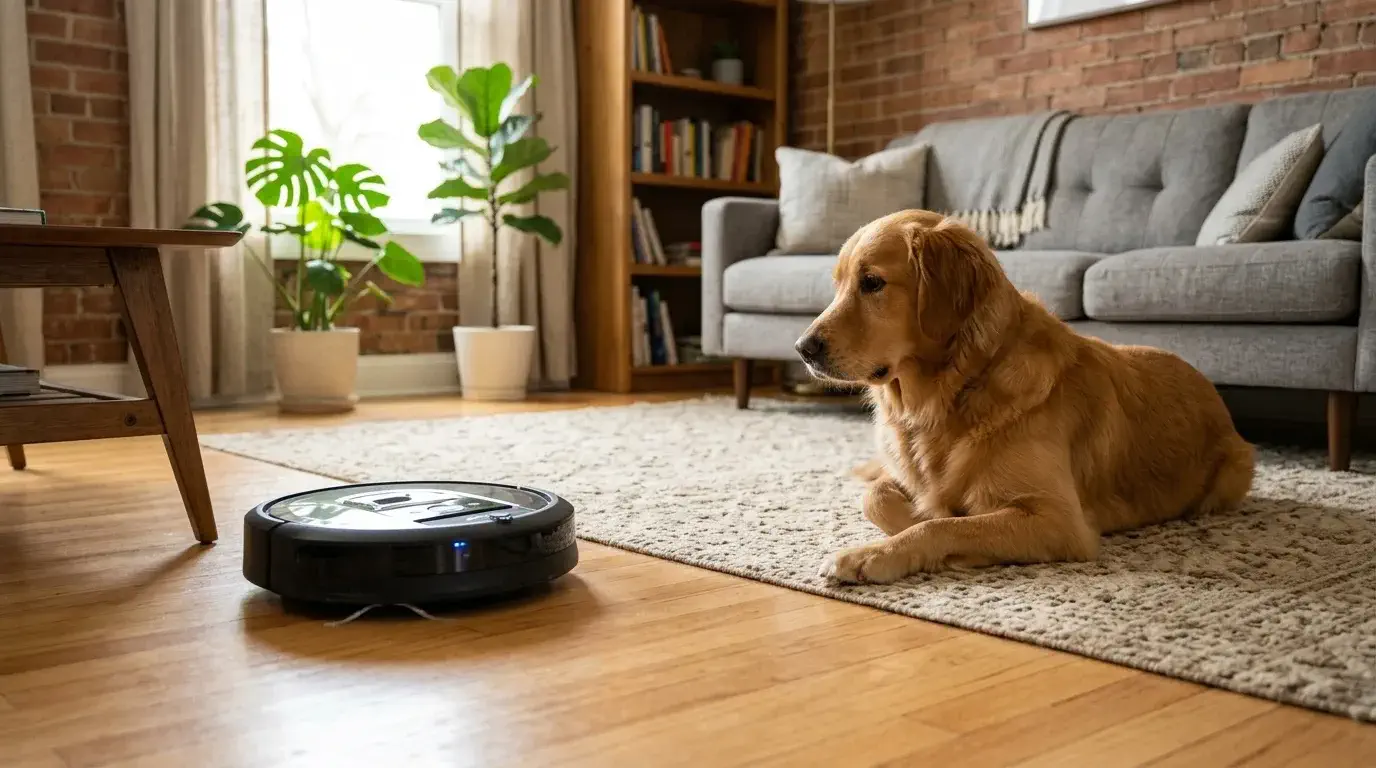
Your robot vacuum just started humming. Your dog froze, ears up, eyes locked on the little disc gliding across the floor.
Smart pet devices and dog behavior are way more connected than most owners realize.
We bring these gadgets home for convenience. Automatic feeders. Robot vacuums. Smart cameras that bark back at our dogs (literally, in some cases).
But our dogs don’t read the marketing copy. They just experience a house that suddenly moves, beeps, and feeds them on its own schedule.
In this guide, we’ll walk through exactly how smart home technology for dogs affects their routine, their stress levels, and their bond with you. We’ll also cover what to do about it, because that’s the part that actually matters.
Why Smart Home Technology is Becoming Part of Every Dog’s Daily Life
Smart devices aren’t a niche thing anymore. They’re just… home now.
Robot vacuums roll under the couch while you’re at work. Feeders dispense kibble before you’re even awake. Cameras let you check on your dog from a meeting three states away.
Here’s the thing nobody mentions in the unboxing videos: your dog doesn’t know these are “helpful tools.” To them, it’s just a new presence in their territory.
A vacuum that moves on its own breaks every rule of what your dog thought a vacuum was. An automatic feeder changes the social contract around mealtime. A camera adds a voice that has no body attached to it.
None of this is automatically bad. But it does mean your dog is constantly adjusting in the background, even when you’re not thinking about it.
How Robot Vacuums Affect Dog Behavior
Quick answer: Robot vacuums can trigger chasing, barking, or fear in dogs because the movement and sound mimic an unfamiliar intruder, but most dogs adjust within a few weeks with the right introduction.
Think about it from your dog’s point of view. A round object glides across the floor by itself. No human is pushing it. It hums. It bumps into furniture. Then it disappears under the couch like it’s hiding.
That’s basically a horror movie plot for some dogs.
Common Reactions Dogs Have to Robot Vacuums
Every dog responds differently, and personality plays a bigger role than most people expect.
- The Chaser: Herding breeds like Border Collies or Australian Shepherds often try to herd or block the vacuum. Their instinct says “control the moving thing.”
- The Guard Dog: Some dogs bark at the vacuum like it just broke into the house. This is a territorial response, not aggression toward you.
- The Scaredy Cat (Dog Edition): Smaller or more sensitive dogs may bolt, hide behind the couch, or shake.
- The “Whatever” Dog: A lot of dogs genuinely couldn’t care less. They step over the vacuum and keep napping.
A popular cleaning brand’s pet guide notes that dogs with strong herding or prey drive are more likely to chase or try to control the device, while more easygoing dogs may largely ignore it.
Real-life example: A friend’s Beagle named Waffles treated her new robot vacuum like a rival dog for an entire week. Barking, blocking its path, the whole show. By week two, Waffles was napping six inches away from it while it ran. That adjustment window is incredibly common.
How to Help Your Dog Adjust to a Robot Vacuum
You don’t need a professional trainer for this one. You need patience and snacks.
- Introduce it powered off first. Let your dog sniff it, walk around it, decide it’s boring furniture.
- Turn it on from a distance. Don’t let it chase your dog around the living room on day one.
- Pair calm behavior with treats. This is positive reinforcement 101: calm dog gets a snack, scared dog gets space.
- Run it while your dog is out of the room initially. A walk or a few minutes in the yard works great.
- Watch body language. Tucked tail, flattened ears, or frantic pacing means back off and slow down.
Expert Tip: Never force your dog to “face their fear” by holding them near the vacuum while it runs. This is a classic mistake that backfires. Flooding a scared dog with the trigger usually deepens the fear instead of fixing it. Slow exposure wins every time.
If you’re building out a full daily structure for your dog (not just vacuum training), our guide on Daily Dog Care Routine breaks down how to layer naps, walks, and quiet time around new household changes like this one.
Automatic Feeders and Their Effect on a Dog’s Routine
Quick answer: Automatic feeders can support a more consistent feeding schedule, which dogs generally respond well to, but they can also reduce the bonding moments that happen during hand-fed mealtimes.
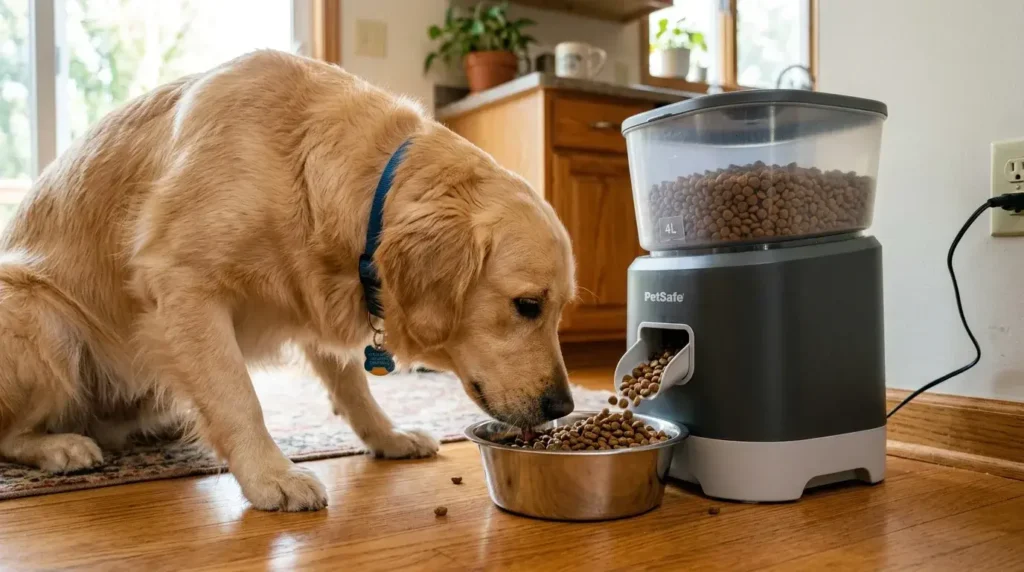
Feeding time isn’t just calories for your dog. It’s a daily ritual. The sound of the bag, the bowl hitting the floor, you standing there while they eat. That’s social information for them.
Swap that out for a machine that drops food at 7:00 a.m. sharp, and you’re changing more than just logistics.
The Good: Routine Consistency and Structure
Dogs are creatures of habit, and the science backs this up hard.
Predictable schedules genuinely calm dogs down. Veterinary behavior resources consistently point out that dogs feel more secure when they can anticipate what’s coming next in their day, including meals, walks, and rest periods, and that this predictability lowers anxiety-related behaviors like pacing or destructive habits, according to the Dogtopia behavior team.
An automatic feeder, used consistently, can actually lock in that predictability better than a busy human schedule sometimes can. No skipped breakfasts because you hit snooze.
The Tricky Part: Missing the Human Connection at Mealtime
Here’s what most articles about automatic feeders skip entirely: the bonding cost.
Feeding your dog by hand, even occasionally, reinforces that you are the source of good things. It’s a small daily deposit into the human-dog bond.
Full automation removes that. Your dog still eats. They just don’t associate you with it as directly.
Practical fix: Use the automatic feeder for consistency, but keep at least one meal or training session a day where you’re physically involved. Hand-feed a portion of dinner. Use kibble for a five-minute training session before the automatic dispenser handles the rest.
This isn’t an all-or-nothing decision. It’s a balance.
| Feeding Method | Routine Consistency | Human Bonding Opportunity | Best For |
|---|---|---|---|
| Fully Automatic Feeder | High | Low | Busy schedules, multi-pet homes, weight management |
| Fully Hand-Fed | Medium (depends on owner) | High | Owners home most of the day, training-focused households |
| Hybrid (Automatic + Hand-Fed Meal) | High | High | Most households, especially working pet parents |
Smart Pet Cameras and Monitoring: Comfort or Confusion?
Quick answer: Smart cameras can ease owner anxiety and offer light enrichment through two-way audio or treat dispensing, but dogs may initially find a disembodied voice confusing rather than comforting.
You know that feeling when you hear someone in another room but can’t see them? Now imagine that’s your entire relationship with this device.
Two-way audio cameras let you talk to your dog from your phone. Some dispense treats with a tap. It sounds great on paper.
In practice, dogs often respond to the voice with confused head-tilting before they connect it to anything meaningful. Repetition is what eventually teaches them “that voice means good things happen.”
Where cameras genuinely help:
- Spotting separation-related distress patterns (so you know if it’s worth addressing)
- Delivering a treat or cue during short absences
- Giving anxious pet parents peace of mind, which indirectly keeps the household calmer
Where they fall short:
- They cannot replace physical presence or actual exercise
- Talking through a speaker doesn’t substitute for real interaction
- Overusing the camera to “check in” constantly can become more about your anxiety than your dog’s needs
A Reddit thread in r/dogs put it well: several owners mentioned their dogs eventually started looking at the camera expectantly after a few weeks of treat-dispensing use, basically learning a new household routine. That’s a great example of dogs adapting to smart tech the same way they adapt to anything else: through repetition.
Interactive Dog Toys and Smart Enrichment Tools
Quick answer: Interactive toys and puzzle feeders support mental stimulation and reduce boredom-driven behaviors like chewing or barking, making them one of the most reliably positive smart additions to a dog’s routine.
This is the category with the least downside. Puzzle toys, treat-dispensing balls, and app-controlled toys tap into something dogs actually crave: a job to do.
The AKC notes that puzzle toys give dogs a physical and mental challenge by making them work for a reward, which matters most when you can’t be around to actively play with them yourself, according to the American Kennel Club.
And the mental fatigue from this kind of play is real. Some trainers compare 15 minutes of mental stimulation to the tiring effect of a much longer walk.
Quick List: Smart and Low-Tech Enrichment Options
- Treat-dispensing puzzle balls
- App-controlled motorized toys
- Slow feeder bowls (low-tech but highly effective)
- Snuffle mats for scent-based enrichment
- Frozen Kong-style toys for longer engagement
If you want a budget-friendly, vet-safe option you can make yourself, check out our DIY Snuffle Mat Without Rubber tutorial. It’s a great pairing with any smart feeder, since it slows down eating while adding scent enrichment.
Expert Tip: Rotate toys weekly instead of leaving all of them out at once. Dogs lose interest in anything that’s always available. Pulling a toy away for a week and reintroducing it often “resets” their excitement for it.
The Bigger Picture: How Smart Devices Reshape a Dog’s Daily Routine
Quick answer: Smart devices reshape a dog’s day by changing timing, sound, and interaction patterns, and the overall effect depends far more on consistency and introduction than on the devices themselves.
Stack a robot vacuum, an automatic feeder, and a smart camera together, and you’ve changed a meaningful chunk of your dog’s daily sensory experience.
Used thoughtfully, this can actually increase environmental enrichment and structure. Used carelessly, it can create a low hum of unpredictability that builds stress over time.
The research on canine stress backs this up. A recent review of cortisol research in dogs notes that pet dogs who experience consistent routines, positive interactions, and enriched environments tend to show more stable stress hormone levels compared to dogs without that structure.
Translation: predictability matters more than any single gadget.
Are Smart Home Devices Good for Dogs? Weighing the Tradeoffs
Honestly, it depends on how you roll them out.
They tend to help when:
- Introduced one at a time, slowly
- Paired with positive reinforcement during the adjustment period
- Used to support routine, not replace human interaction
They tend to cause problems when:
- Multiple devices show up at once with zero introduction
- Owners assume “set and forget” applies to their dog’s emotional adjustment too
- Tech replaces walks, play, or actual together-time instead of supplementing it
So it’s not really a yes or no question. It’s a “how” question.
Separation Anxiety and Smart Devices: What Owners Should Know
Quick answer: Smart cameras and automatic feeders can support a dog’s sense of routine while you’re away, but they are not a fix for separation anxiety on their own, and physical exercise plus mental stimulation still matter most.
Marketing for pet tech loves the phrase “perfect for dogs with separation anxiety.” That’s a stretch.
According to the ASPCA, common signs of distress in dogs left alone include pacing, panting, trembling, and excessive vocalizing, and the most effective interventions involve gradual desensitization to being alone rather than any single product.
What smart devices can do:
- Maintain a predictable feeding rhythm, which supports a sense of safety
- Offer occasional interaction through two-way audio
- Provide a “job” through treat-dispensing puzzle features
What they can’t do:
- Replace the actual desensitization process of building up alone-time tolerance
- Substitute for daily exercise, which the ASPCA notes is one of the most effective tools for easing anxiety-related behaviors, per the ASPCA Pet Health Insurance team
- Fix a dog’s emotional state through a screen
If your dog shows ongoing distress when left alone, that’s a behavior pattern worth addressing directly through routine and training, not a gadget purchase.
Pro Tips for Introducing Smart Devices Without Stressing Your Dog
Here’s the stuff that actually works, gathered from trainers, owners, and a lot of trial and error across pet-owning households.
- One device at a time. Give your dog two to three weeks to adjust before adding the next one.
- Schedule new device introductions for calm times of day. Not right after a stressful vet visit or a thunderstorm.
- Keep your own routine anchored. Walks, greetings, and bedtime should stay consistent even as tech changes around your dog.
- Use treats generously during the first week. Every calm interaction with a new device deserves a reward.
- Watch for stress signals, not just obvious fear. Lip licking, yawning, and avoiding eye contact can be early stress cues too.
- Let your dog set the pace. If they need three weeks instead of three days, that’s fine.
Expert Tip: Film the first few interactions on your phone. Owners often miss subtle stress signals in real time but catch them easily on playback. It’s a simple way to course-correct early.
Common Mistakes Pet Owners Make With Smart Pet Tech
Let’s talk about what goes wrong, because almost every pet parent makes at least one of these.
- Introducing everything at once. New vacuum, new feeder, new camera, same week. Dogs need time to process one change before the next.
- Ignoring fear signals because “they’ll get used to it.” Sometimes they will. Sometimes the fear gets worse and turns into a long-term issue.
- Relying on cameras instead of presence. Checking in remotely is not a substitute for actual time together.
- Inconsistent feeder scheduling. Changing feeding times constantly defeats the entire purpose of automation.
- Leaving a vacuum running unsupervised on day one. Always supervise the first several runs.
- Assuming all dogs react the same way. A neighbor’s dog ignoring the vacuum doesn’t mean yours will.
Myths vs Facts: Smart Pet Devices and Dog Behavior
| Myth | Fact |
|---|---|
| “Robot vacuums always scare dogs.” | Many dogs adjust within one to two weeks with a slow introduction. Reaction varies heavily by personality and breed instinct. |
| “Automatic feeders ruin the human-dog bond.” | They only reduce bonding if you remove yourself from mealtime entirely. A hybrid approach preserves the connection. |
| “Smart cameras can treat separation anxiety.” | They can support routine but are not a standalone fix. Real desensitization and exercise matter more. |
| “More smart devices mean a smarter, happier dog.” | Stacking too many changes at once can create stress. Pacing matters more than quantity. |
Conclusion
Smart pet devices and dog behavior are tied together more closely than most product packaging admits.
None of these gadgets are inherently good or bad for your dog. The real factor is how thoughtfully you bring them into the house.
Introduce one thing at a time. Keep treats handy. Don’t let automation replace the walks, the play, and the time you spend actually being present.
Your dog doesn’t care how smart your home is. They care that you’re still you, showing up the same way you always have, gadgets or not.
FAQs
How do robot vacuums affect dog behavior?
Robot vacuums can trigger chasing, barking, or fear due to their unexpected movement and sound. Most dogs adjust within one to two weeks when introduced gradually with positive reinforcement.
Can automatic feeders change a dog’s routine?
Yes, automatic feeders create a highly consistent feeding schedule, which most dogs respond well to. The tradeoff is fewer hands-on bonding moments at mealtime unless you stay involved with at least one feeding a day.
Are smart home devices good for dogs?
It depends on how they’re introduced. Slow, one-at-a-time rollouts paired with positive reinforcement tend to work well. Sudden, simultaneous introductions tend to cause stress.
How does technology change dog behavior at home?
Smart devices change the sounds, timing, and interaction patterns your dog experiences daily. This can increase structure and enrichment when managed well, or create mild unpredictability when introduced carelessly.
Do smart pet cameras help with separation anxiety?
They can support a sense of routine and offer light interaction, but they aren’t a standalone treatment. Exercise, mental stimulation, and gradual alone-time training matter more for genuine separation anxiety.
What’s the best way to introduce a new smart device to my dog?
Start with the device powered off, let your dog investigate it, then introduce sound and movement gradually from a distance. Reward calm behavior throughout the process and never force interaction.