
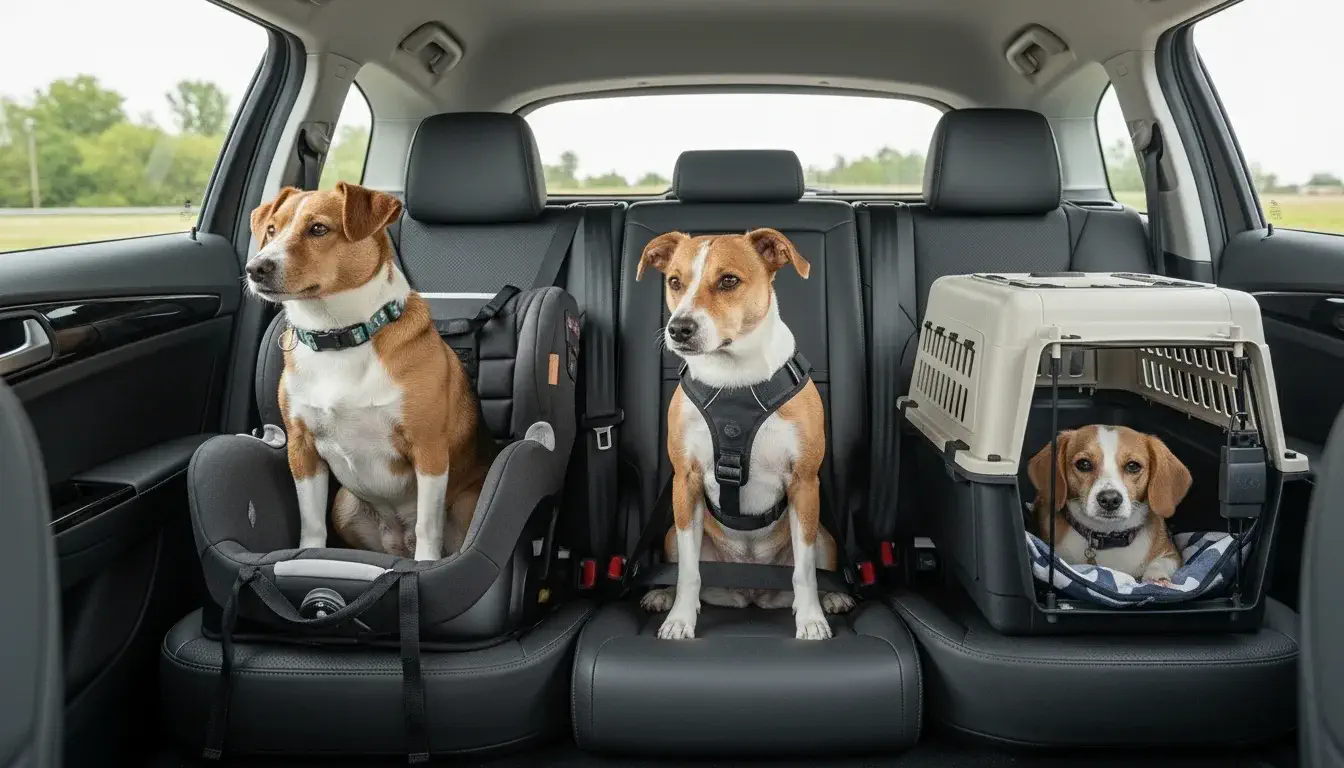
You’re on the highway, your Labrador has his head out the window, ears flapping like little wings. It looks adorable. It looks harmless.
But here’s the thing, that same lovable dog becomes a 1,500-pound force of impact in a 30 mph crash. That’s not a scare tactic. That’s physics.
According to a landmark study by AAA/Kurgo, 84% of dog owners admit to being distracted by their unrestrained pets while driving. Yet only 16% actually use any form of restraint.
We love our dogs like family. But a lot of us are accidentally treating car rides like a free-for-all.
In this guide, we’re breaking down the three main dog car safety options: dog car seats, crates, and harnesses. We’ll compare them honestly, call out the myths, and help you figure out which one actually fits your dog and your life.
Why Dog Car Safety Matters More Than You Think
The Real Risk of an Unrestrained Dog in a Moving Vehicle
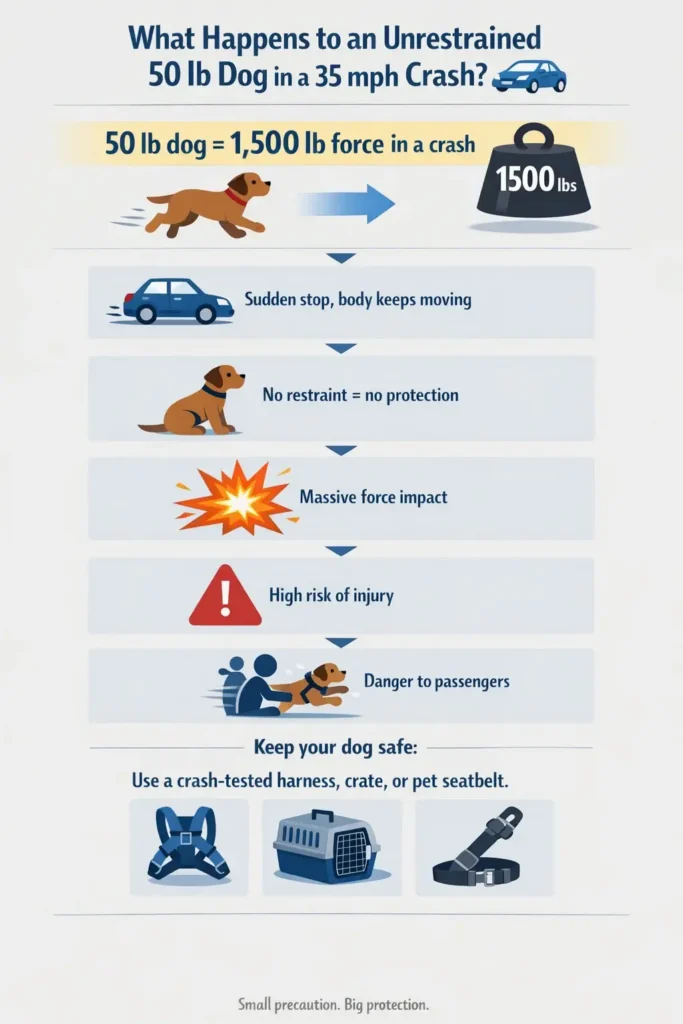
Here’s a number that stops most dog owners cold.
A 60-pound dog traveling at 35 mph becomes roughly a 2,700-pound projectile in a crash. That’s the weight of a small car hitting your dashboard, your seat, or your child sitting next to them.
Unrestrained pets are a leading cause of distracted driving incidents in the U.S. Dogs climbing into laps, pawing at the gear shift, or blocking rear-view mirrors contribute to thousands of accidents every year.
Beyond crashes, a loose dog in the cabin is just a distraction waiting to happen, even on the most routine grocery run.
A few U.S. states, including New Jersey and Hawaii, have laws addressing pet restraint in vehicles. We’re not here to give legal advice, but it’s worth knowing that the conversation around pet car safety is getting more serious at a policy level.
The good news? You have three solid options to choose from.
Dog Car Seats: Cute Booster or Legitimate Safety Tool?
Dog car seats look adorable. They also confuse a lot of people.
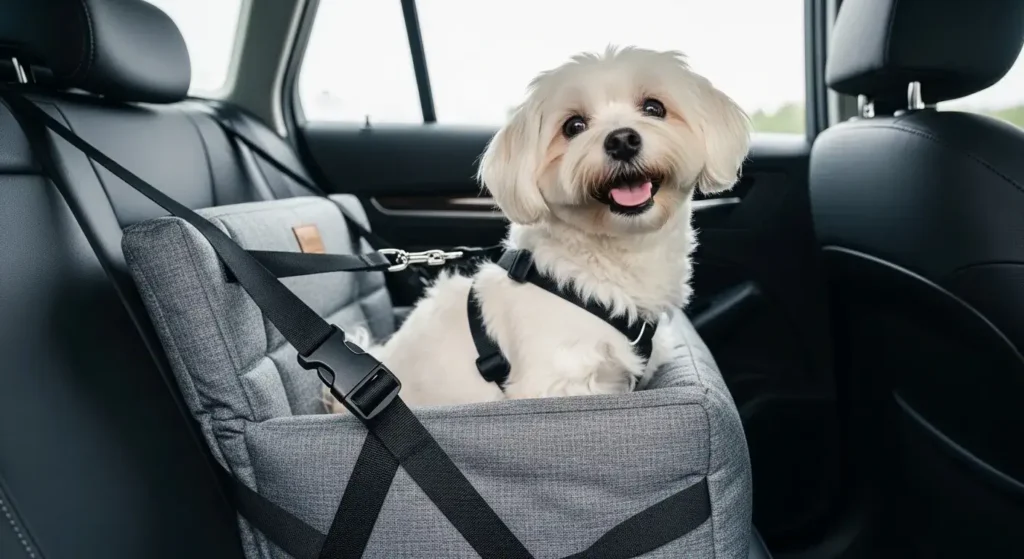
Here’s the honest answer: a dog car seat is primarily a containment and comfort tool, especially for small dogs. It is NOT a crash-protection device on its own.
Most dog car seats are booster-style or bucket-style seats that elevate your dog so they can see out the window. They attach to your vehicle’s seat belt system and include a short tether that clips to your dog’s harness.
Pros of Dog Car Seats
- Keeps small dogs contained without the bulk of a crate
- Reduces anxiety for dogs who feel calmer when elevated
- Easy to move between vehicles
- Works great for short urban drives and errands
Cons of Dog Car Seats
- Most are NOT crash-tested to any independent safety standard
- Only suitable for dogs under 20 pounds
- Without a proper harness attached, the tether can cause neck injury
- Can give owners a false sense of security
Best Use Case for Dog Car Seats
Dog car seats shine brightest for small breeds like Chihuahuas, Maltese, Yorkies, and Shih Tzus.
If your dog has car anxiety and feels better when they can see out the window, a booster-style seat can genuinely help with that. Just always pair it with a properly fitted harness, never clip it to a collar.
Expert Tip: Always use a car seat in combination with a crash-tested harness. The seat provides positioning and comfort. The harness provides actual safety in a sudden stop or collision.
| Feature | Dog Car Seat |
|---|---|
| Best For | Small dogs under 20 lbs |
| Crash Tested? | Rarely |
| Anxiety-Friendly? | Yes |
| Works in All Vehicles? | Yes |
| Ease of Use | Very easy |
Dog Crates for Car Travel: When Bigger Really is Better
For large and extra-large dogs, a properly secured crate is widely considered the gold standard of car safety.
And that one word, “secured,” makes all the difference.
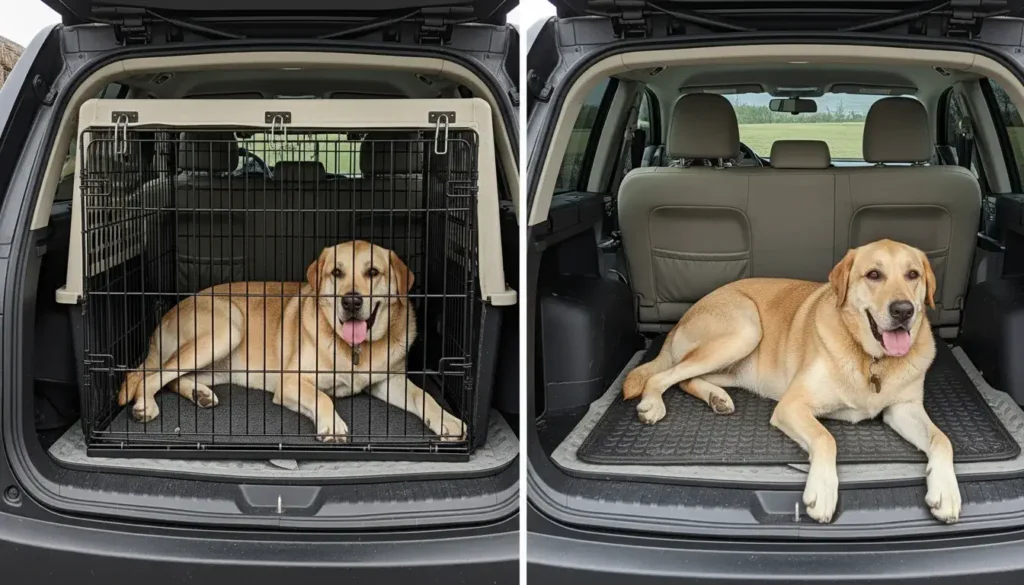
A loose crate sliding around your cargo area in a crash is not protecting anyone. In fact, it becomes its own hazard. The crate must be anchored to the vehicle using tie-down straps or cargo hooks.
Pros of Dog Crates in Cars
- Maximum containment, your dog physically cannot roam the cabin
- Crash-tested aluminum crate options are available
- Familiar den-like environment reduces anxiety for crate-trained dogs
- Best overall protection in rollovers and rear-end collisions
- Works well when traveling with multiple dogs
Cons of Dog Crates in Cars
- Takes up significant cargo space (tough in sedans, ideal in SUVs)
- Heavy and inconvenient to move between vehicles
- Can overheat in summer without proper ventilation
- Dogs who aren’t crate-trained may find it stressful
- Quality crash-tested crates can be a significant upfront cost
What is the Safest Way to Transport a Large Dog in a Car?
Great question, and the answer is straightforward.
For a dog over 60 pounds, a properly anchored, hard-sided crash-tested crate placed in the cargo area of an SUV or wagon is your safest bet. Brands offering aluminum crates with integrated tie-down systems provide the most robust protection currently available.
According to the Center for Pet Safety’s comparative restraint study, no soft-sided crate passed their crash simulation tests. Hard-sided and specifically designed travel crates performed significantly better.
If you drive a sedan and own a large dog, a crash-tested harness becomes your best alternative since a full crate simply won’t fit safely.
Expert Tip: Place the crate in the cargo area behind the rear seats, never in the back seat itself. In a rear-end collision, the cargo area provides the most structural protection in most SUV body styles.
Dog Harnesses for Car Travel: The Everyday Champion
Car harnesses are the most versatile, most accessible option for the majority of dog owners.
But here’s where a lot of people get it wrong: your regular walking harness is NOT a car harness.
A walking harness is designed to redirect pulling energy during walks. It is not engineered to handle crash forces. Using one in the car is better than nothing, but it’s not a real safety solution.
A car-specific harness clips directly into your vehicle’s seat belt buckle and is designed to distribute the force of a collision across your dog’s chest and shoulders, not their neck.
Pros of Dog Car Harnesses
- Works in virtually any vehicle: sedans, SUVs, trucks, and minivans
- No extra gear needed beyond the existing seat belt slot
- Available in sizes for all dogs
- Allows comfortable movement on long road trips
- Some models double as walking harnesses
Cons of Dog Car Harnesses
- Quality varies wildly, cheap harnesses fail crash tests routinely
- Incorrect fit reduces effectiveness significantly
- Requires consistent use every single trip (human compliance is the real challenge here)
- Not ideal for extremely anxious dogs who need more containment
What is a Crash-Tested Dog Harness and Why Does It Matter?
Not all harnesses labeled “safety” or “car harness” are actually crash-tested.
Crash-tested means the harness was evaluated at an independent certified facility, such as MGA Research Corporation, using the same standards applied to child safety restraints.
The Center for Pet Safety conducts rigorous crash-test evaluations on pet restraint products. Only a small number of harnesses have earned their certification. Look specifically for CPS Certified or equivalent independent crash-test ratings, not vague marketing language like “quality tested” or “safety designed.”
Is It Safe for Dogs to Ride in the Front Seat?
Short answer: NO.
In a frontal collision, airbag deployment can cause serious injury to dogs positioned in the passenger seat. The airbag deploys at roughly 100-220 mph. Even in minor fender-benders, the force is enough to cause significant harm to an animal that size.
The British Columbia Society for the Prevention of Cruelty to Animals recommends always placing dogs in the back seat or cargo area. The front seat, even with a harness, introduces unnecessary airbag risk.
Dog Car Seat vs Crate vs Harness: The Side-by-Side Breakdown
Here is where we bring it all together.
| Criteria | Car Seat | Crate | Harness |
|---|---|---|---|
| Safety Level | Low-Medium | High (if anchored) | Medium-High (if crash-tested) |
| Best Dog Size | Under 20 lbs | 40 lbs and up | All sizes |
| Works in Sedan? | Yes | Difficult | Yes |
| Works in SUV? | Yes | Ideal | Yes |
| Crash Tested Available? | Rarely | Yes | Yes (select brands) |
| Anxiety-Friendly? | Yes | Yes (if crate-trained) | Moderate |
| Ease of Use | Very Easy | Moderate | Easy |
Best Pick by Dog Size
- Small dogs (under 20 lbs): Booster car seat combined with a crash-tested harness
- Medium dogs (20 to 60 lbs): Crash-tested car harness in the rear seat
- Large and extra-large dogs (60+ lbs): Anchored hard-sided crate in cargo area, or a crash-tested harness as an alternative
Best Pick for Anxious Dogs
Dogs with car anxiety often do better with containment than open restraint.
For anxious small dogs, the elevated view from a booster seat can actually reduce stress. For larger anxious dogs, a familiar crate they already use at home can feel like a safe den on wheels.
Pairing any restraint with short desensitization practice trips before longer journeys makes a real difference. We’ll cover that in the tips section next.
7 Pro Tips for Safer Dog Car Travel (Most Owners Skip #4)
- Always pair a car seat with a harness. The seat alone offers zero crash protection.
- Never clip any car restraint to a collar. Always connect to the harness chest ring.
- Anchor your crate with tie-down straps. Friction alone won’t hold in a crash.
- Introduce the restraint at home first. Let your dog sniff, sit in, and get comfortable before ever leaving the driveway. This one step prevents most car anxiety issues.
- Keep windows cracked, not fully open. Fully open windows risk eye injuries from debris and ear damage from wind pressure at highway speeds.
- On road trips, stop every 2 hours. Dogs need bathroom breaks and a chance to reset just like we do.
- Never leave your dog in a parked car. Even on a mild 70-degree day, car interiors can reach 113 degrees within an hour, according to No Heat Stroke.
5 Common Mistakes Dog Owners Make on Car Trips
Mistake 1: Using a regular walking harness for car travel. It wasn’t designed for crash forces. It will likely fail in an accident.
Mistake 2: Placing a crate in the back seat. Crates belong in the cargo area. In the back seat, they can become dangerous projectiles during frontal or side-impact crashes.
Mistake 3: Letting the dog ride upfront “just this once.” There is no such thing as a safe “just this once” when airbags are involved.
Mistake 4: Choosing based on looks and price alone. A $15 harness from a discount store with zero crash-test data is not a safety product. It’s a leash holder.
Mistake 5: Skipping restraint for short trips. Most serious accidents happen within 25 miles of home. Short trips don’t mean safe trips.
Dog Car Safety Myths vs. Facts
| Myth | Fact |
| “My dog is well-behaved, he doesn’t need restraint.” | Even the calmest dogs become dangerous projectiles in a crash. Behavior doesn’t change physics. |
| “A seat belt attachment is the same as a crash-tested harness.” | Most seat belt clip attachments have no independent safety rating and can snap under crash force. |
| “Crates are cruel in cars.” | A secured, properly sized crate is the most protective environment available for large dogs. |
| “My dog hates being restrained, so it’s kinder to leave him loose.” | With gradual desensitization, most dogs accept and even enjoy their car routine. The stress is temporary. The safety is permanent. |
So, Which Option Is Actually the Safest?
Here’s the straight answer.
If you have a small dog: use a booster car seat combined with a crash-tested harness. You get comfort, containment, and real crash protection all in one setup.
If you have a large dog and an SUV or wagon: a properly anchored, hard-sided crash-tested crate in the cargo area is the safest option currently available.
If you want one solution that works for any dog in any car: a crash-tested harness from a CPS-certified or independently tested brand is your go-to.
The best restraint is ultimately the one you use correctly on every single trip, even the five-minute ones.
Your dog has zero concept of road risk. They just know they love riding with you. That total, unconditional trust is kind of the whole point. A little prep before every trip is the easiest way to honor it.
Frequently Asked Questions
What is the safest way to transport a large dog in a car?
A properly anchored, hard-sided crash-tested crate in the cargo area of an SUV or station wagon. If space doesn’t allow a crate, a CPS-certified crash-tested harness in the rear seat is the next best option.
Can dogs ride in a car without a crate or harness?
Technically yes, but it significantly increases the risk of injury to the dog, the driver, and other passengers in the event of any sudden stop or collision. Several U.S. states also have pet restraint statutes worth knowing about.
Is it safe for dogs to ride in the front seat?
No. Airbag deployment in a frontal collision poses a serious injury risk to dogs in the passenger seat. Always place your dog in the back seat or cargo area.
What’s the difference between a crash-tested harness and a regular dog harness?
A regular walking harness is designed to redirect leash pulling. A crash-tested harness is engineered and independently certified to withstand the forces of a vehicle collision. They look similar. They perform very differently.
How do I keep my dog calm in the car without medication?
Start with short, positive practice trips before longer journeys. Use familiar scents like a worn t-shirt on the seat. Keep the cabin cool and quiet. Pair the restraint with high-value treats to build a positive association. Most dogs adapt quickly once the routine becomes familiar.
Are dog car seats actually safe for small dogs?
They’re safe for containment and comfort when paired with a proper harness. Alone, most car seats provide minimal crash protection. Think of the car seat as the comfortable chair and the harness as the actual seatbelt.