Quick Summary
Bell training teaches your dog to ring a hanging or wireless bell near your door as a clear signal to go outside for potty. Using positive reinforcement, most dogs learn in 1–3 weeks. It eliminates guesswork, reduces indoor accidents, and builds lasting communication between you and your pet.
You’re in the middle of a Zoom call when you notice it, that unmistakable puddle near the hallway rug. Sound familiar? At Pet Civic, we hear this story constantly. One of the most frustrating parts of pet ownership isn’t the accident itself, it’s the fact that your dog was trying to tell you, and you simply missed the signal.
Scratching at the door. Circling near the entryway. A long stare that you misread as boredom. These vague cues leave pet owners guessing every time. That’s where dog bell training for potty changes everything.
Bell training gives your dog a clear, consistent, unmissable way to say: “I need to go outside right now.”
In this guide, you’ll learn the complete step-by-step dog bell training method for beginners, tips tailored to puppies and adult dogs, common mistakes to sidestep, and pro strategies to make the habit stick for life.
What is Dog Bell Training?
Dog bell training for potty is a form of dog communication training where you teach your dog to ring a bell hung near your exit door, every time they need to go outside to relieve themselves.
The logic is beautifully simple: dog touches bell → door opens → dog goes outside to potty → dog gets rewarded. Repeat until it’s muscle memory.
Compared to interpreting ambiguous signals, a bark that might mean hunger, a scratch that might mean play, a bell is unambiguous. It’s a learned behavior built on positive reinforcement training, meaning the dog earns something good (a treat, praise, a trip outside) for doing the right thing.
- Works for puppies as young as 8 weeks
- Equally effective for adult dogs new to the method
- Compatible with all breeds and sizes
- Rooted in operant conditioning — the same science behind service dog training
Through our research into pet wellness, Pet Civic has found this method to be one of the most accessible DIY training approaches for American households, requiring no professional trainer or specialized equipment.
Pet Civic Expert Tip:
Keep training sessions to 3–5 minutes. Dogs, especially puppies, hit a learning wall fast. Short bursts beat long marathons every time.
Benefits of Teaching Your Dog to Ring a Bell
The potty training dog with bell method offers advantages that go well beyond just avoiding carpet stains:
- Crystal-clear communication: Removes the ambiguity of tail chasing, door staring, or unnecessary barking.
- Encourages dog independence: Your dog learns to self-advocate, reducing anxiety around bathroom needs.
- Strengthens your bond: Reward-based dog training releases dopamine in both the dog and owner. It’s science-backed bonding.
- Works for busy households: Especially valuable in multi-person homes or if you work from home and can’t always watch for subtle cues.
What You Need Before Starting
Before your first dog doorbell training session, gather these essentials:
| Item | What to Look For | Estimated Cost (USA) |
|---|---|---|
| Hanging door bells | Nylon strap with 2-3 jingle bells; hangs on doorknob | $8-$15 |
| Wireless dog doorbell | Button sensor + receiver; louder alert; works through walls | $20-$45 |
| High-value treats | Small, soft, smelly (e.g., Zuke’s Mini Naturals, Blue Buffalo Bits) | $6-$12/bag |
| Clicker (optional) | Marks correct behavior with precision | $3-$8 |
| Leash | Standard 4-6 ft leash for outdoor portion of training | Already owned |
Place the bell at your dog’s nose height on the door you always use for outdoor trips. Consistency of location is non-negotiable — always the same door.
Pet Civic Tip:
At Pet Civic, we prefer hanging bells for beginners – they’re cheaper, require no batteries, and the sound is naturally engaging to dogs.
Step-by-Step Dog Bell Training for Beginners
This is the core of your dog doorbell training steps. Follow each stage in sequence, don’t skip ahead.
Step 1: Introduce the Bell
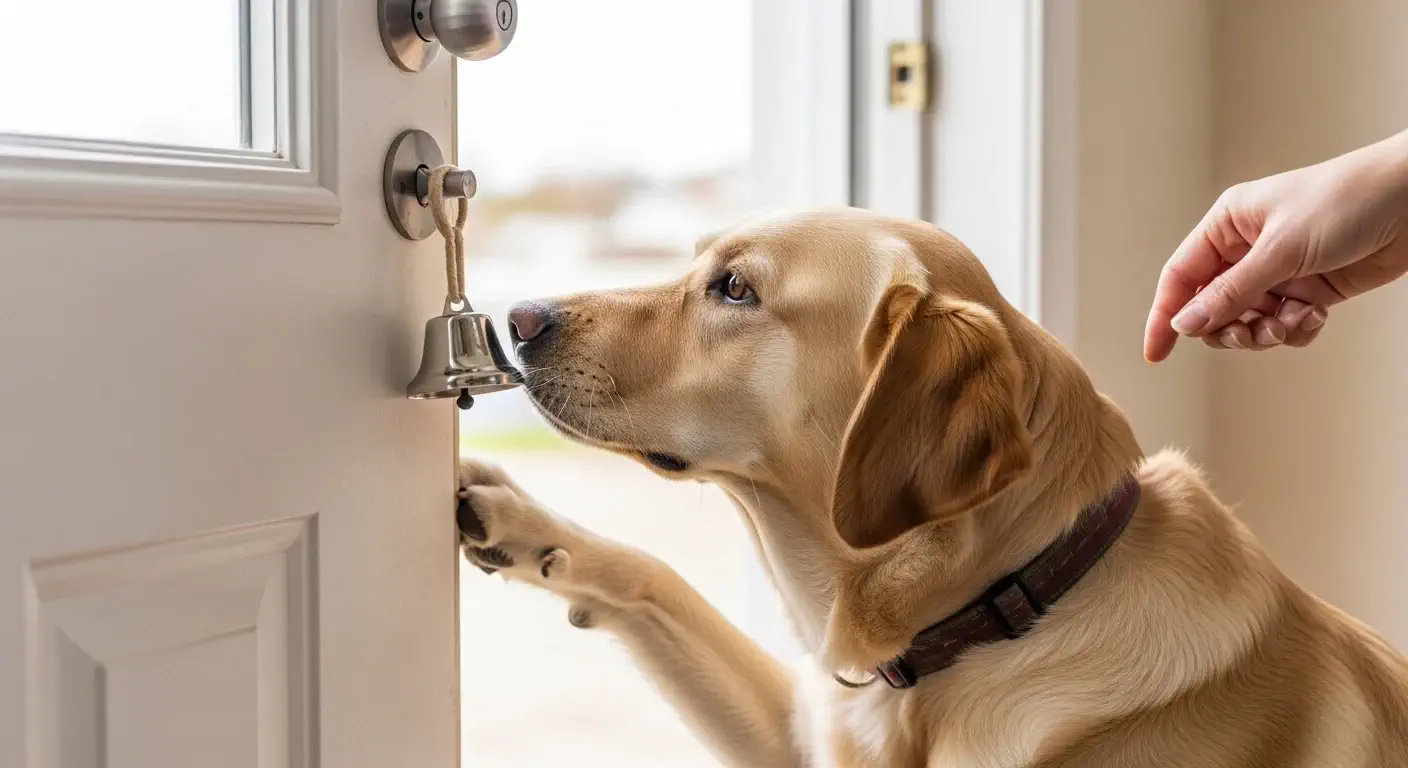
Hang the bell on the door at your dog’s nose level. Let your dog approach and sniff it naturally. The moment their nose or paw touches the bell even accidentally, immediately reward with a treat and enthusiastic praise. Repeat 5-10 times in a single short session. You’re building curiosity and positive association with this new object.
Step 2: Teach Your Dog to Touch the Bell
Hold a treat behind the bell or rub it on the bell to attract your dog’s nose. The second they touch it, say your cue word “bell” or “touch” and deliver the treat. This is positive reinforcement training at its most fundamental. Practice this until your dog is deliberately nudging the bell on command, not just by accident. Most dogs reach this point in 1-3 days.
Step 3: Connect Bell with Going Outside
Now you add the crucial cause-and-effect relationship. Every single time you take your dog outside for a potty trip, gently guide their paw or nose to ring the bell first, then immediately open the door. You’re installing the mental link: ring bell = door opens. Do this consistently for at least 5-7 days before expecting the dog to initiate it solo.
Step 4: Encourage Your Dog to Ring the Bell
During a scheduled potty break, stand near the door and wait. Don’t prompt. Watch for any interaction with the bell. The moment your dog touches it, open the door immediately and go straight outside. Once they go potty outdoors, give a high-value treat and big praise. This is the “aha” moment most dogs have within the first two weeks. The behavior is now self-reinforcing.
Step 5: Build a Consistent Potty Routine
A strong dog bell routine requires a regular potty schedule. Take your dog out: first thing in the morning, after every meal, after naps, after play, and before bed. Always require the bell ring before opening the door. Over 2-4 weeks, gradually reduce food treats but maintain verbal praise “good bell!” every single time. The behavior will become fully habitual.
Pet Civic Expert Tip:
USDA-approved low-calorie training treats like chicken or turkey bits keep training sessions frequent without risking weight gain — especially important for breeds like Labs and Beagles who are prone to obesity.
Easy Way to Teach a Puppy to Ring a Bell
Puppies are learning machines but only in short bursts. Here’s how to make bell training puppy-friendly:
- Keep sessions to 2-3 minutes max; puppies lose focus fast
- Schedule training right before you know they need to go (15-20 mins after eating)
- Use an upbeat, playful tone make it feel like a game, not a lesson
- Never punish accidents, redirect and restart. Punishment slows learning and damages trust.
- Aim for 4-6 repetitions per session, 2-3 sessions per day
- Celebrate every single bell touch even the accidental ones in the first few days
Puppies 8-16 weeks often catch on faster than older dogs because they haven’t yet formed alternative signaling habits. Their blank slate is an advantage.
Pet Civic Tip:
If your puppy is a chewer, opt for a wireless doorbell with a wall-mounted button — no jingle bell strands for them to destroy (or swallow).
How Long Does It Take to Bell Train a Dog?
Most dogs demonstrate a reliable bell-ringing habit within 1-3 weeks of consistent training. But several variables affect the timeline:
| Factor | Faster Learning | Slower Learning |
|---|---|---|
| Age | Puppies 8-16 weeks | Senior dogs (7+ years) |
| Prior training | Already knows “sit,” “touch” commands | No prior obedience background |
| Breed | Border Collies, Poodles, Labs (high trainability) | Basenjis, Chow Chows (more independent) |
| Consistency | Same door, same bell, same routine daily | Multiple trainers with different rules |
| Treat quality | High-value soft treats used every time | Dry kibble or inconsistent rewards |
The single most important factor is Consistency. Dogs don’t generalize well. If the routine breaks for even 3-4 days, you may need to restart from Step 3.
Expert Tip:
If you’re not seeing progress after 3 weeks, consult an AKC Canine Good Citizen certified trainer. A single session can identify where the learning chain is breaking.
Common Mistakes to Avoid
At Pet Civic, we’ve observed these errors trip up even the most dedicated pet owners during housetraining with bells:
- Inconsistency: Skipping the bell even once when you’re in a hurry teaches your dog the bell is optional. It isn’t.
- Ignoring the bell: If your dog rings and you don’t respond within 10–15 seconds, the signal loses meaning. Drop what you’re doing.
- Delayed treats: Rewards given more than 2 seconds after the behavior aren’t connected to it in the dog’s mind. Timing is everything.
- Punishing accidents: Rubbing a dog’s nose in a mess is ineffective and cruel. It creates anxiety around bathroom behavior, not understanding.
- Letting play-rings slide: Some dogs figure out that ringing the bell = outdoor freedom and start doing it constantly. See FAQ #3 below.
- Multiple doors: Using two or three different doors confuses the association. One door only, especially in the first month.
Common Pitfall:
Never scold your dog for ringing the bell, even for false alarms. Scolding at the bell breaks the entire trained association. Manage play-rings with routine, not punishment.
Pro Tips for Successful Dog Bell Training
These advanced strategies separate average results from an airtight dog bell routine:
- Respond within 10 seconds every time — consistency in your response shapes consistency in theirs
- Add a verbal cue — say “outside?” or “go potty!” as you open the door; over time this phrase alone can prompt bell use
- Use the same leash routine — clip the leash the same way each potty trip; the ritual reinforces the purpose of the trip
- Fade treats gradually — move from treat every time → treat every other time → random reinforcement (intermittent is actually more powerful long-term)
- Don’t linger outside if they rang just to explore — give 2 minutes, and if no potty occurs, come back inside without a reward
- Keep a training log for the first two weeks — note time, bell use, and outcome; patterns help you identify gaps
- Celebrate milestones — if your dog self-initiates for the first time, make it a party; that enthusiasm signals to them they did something exceptional
Conclusion
Bell training is one of the simplest, most effective tools in a dog owner’s toolkit. It requires no special talent, no expensive classes, and no complicated equipment — just a bell, some high-value treats, and the consistency to follow through.
What you get in return is profound: a dog who can clearly communicate a basic need, fewer accidents, less stress, and a stronger bond built on mutual understanding.
Start today. Hang the bell. Let your dog sniff it. Give a treat. You’ve already begun.
Your dog can learn this faster than you think and the first time they ring that bell on their own and look back at you, tail wagging, waiting for you to open that door, you’ll know it was worth every treat.
We’d love to hear how it goes, drop your story in the comments below or explore our other Pet Civic training guides for next steps on your journey together.
Frequently Asked Questions
How do I start training my dog to ring a bell to go outside?
Start by hanging a bell at your dog’s nose height near your exit door. Let them sniff it, and reward any contact immediately with a high-value treat. Repeat 5-10 times per short session. Once curious interaction is reliable, begin guiding their nose to the bell before every single potty trip.
Can older dogs learn bell training for potty?
Yes, absolutely. Adult and senior dogs may take a little longer than puppies, closer to 3-4 weeks but they respond well to reward-based training at any age. Patience and consistency are the keys. Older dogs often have stronger focus than puppies, which actually helps.
What if my dog keeps ringing the bell just to go outside and play?
This is a common and manageable issue. When you go outside and your dog doesn’t potty within 2 minutes, come back inside calmly with no treat and no play. The trip becomes boring. True potty trips get big rewards. Over time, your dog learns the bell has one specific purpose not outdoor playtime on demand.
How often should I practice dog bell training?
Align practice with your dog’s natural potty schedule typically 4-6 trips per day for adult dogs, more for puppies. Every single potty trip should involve the bell during training. Outside of that, don’t run isolated “bell drills” the context of needing to go outside is part of what makes the training stick.
Is bell training better than traditional potty training methods?
Bell training doesn’t replace traditional potty training, it enhances it. A regular schedule, supervision, crate training, and positive reinforcement still form the foundation. The bell adds a communication layer that makes the whole system more reliable. Think of it as adding a clear “send signal” to an already solid system.
What type of bell works best for dog potty training?
For most beginners, hanging jingle bells on a nylon strap (like Caldwell’s or Mighty Paw brands, available on Amazon USA) are ideal, cheap, durable, and naturally appealing to dogs. Wireless doorbells (like the Mighty Paw Smart Bell) are better for larger homes, apartments with thin walls, or dogs who are heavy chewers. Both work equally well when used consistently.