So your adorable little furball has officially turned your hands into chew toys?
One minute you’re playing on the floor, next minute your puppy is latched onto your ankle like it’s a squeaky toy. And man, those tiny teeth are sharp!
Here’s the good news: every single puppy goes through this phase. It’s completely normal, and no, you don’t have a “bad” puppy. You just have a puppy.
The even better news, you can stop it. With the right approach, you can teach your pup what’s okay and what’s off-limits, without yelling, punishing, or losing your sanity.
In this guide, I’m going to walk you through exactly how to stop a puppy from biting hands and feet using fast, proven training methods. We’ll cover why puppies bite in the first place, step-by-step training, what mistakes to avoid, and some bonus tips to speed things up.
Let’s get your hands back in one piece.
Why Does My Puppy Bite My Hands and Feet?
Before you can fix the problem, it helps to understand what’s driving it. Puppy biting isn’t random. There’s usually a reason behind every little nip.
1. Teething Phase (Natural Instinct)
Just like human babies, puppies teethe. Their gums are sore, and chewing helps relieve that discomfort. Between 3 to 6 months of age, teething is at its peak, and your puppy is desperately looking for something to gnaw on.
Your hand just happens to be in the wrong place at the right time.
2. Play Behavior and Exploration
Puppies don’t have hands. So they use their mouths to explore the world. Your wiggling fingers and moving feet are irresistible targets.
This is completely natural puppy behavior. They aren’t being aggressive. They’re just curious, playful little creatures doing what comes naturally.
3. Attention-Seeking Behavior
Here’s a fun one. Sometimes your puppy bites you because it works. You react, they get your attention, and boom, the behavior gets reinforced.
If every time your pup nips you, you squeal, jump, or even push them away, they may see that as an invitation to play more. Puppies love reactions.
4. Overexcitement and Lack of Impulse Control
Ever seen a puppy hit that “zoomies” mode? When they’re overstimulated, they lose control. That’s when nipping at feet or ankles goes into overdrive.
Young puppies simply haven’t developed impulse control yet. It takes time, patience, and consistent training.
Puppy Biting vs Normal Chewing: What’s the Difference?
This question trips up a lot of new pet parents. There is a difference, and it matters.
Chewing is when your puppy gnaws on objects: toys, furniture legs, your favorite sneakers. It’s self-soothing behavior, usually calm in nature.
Biting is directed at people. It’s interactive. Your puppy is choosing you as the target, which is what we need to address with training.
Why does the distinction matter? Because the training approach is different.
For chewing on objects, you redirect to appropriate items and puppy-proof your home. For biting people, you need to teach bite inhibition and set clear boundaries.
Quick example: your pup chewing a rope toy? Fine. Your pup chewing your arm during playtime? That’s the behavior we’re fixing today.
When Should You Be Concerned About Puppy Biting?
Most puppy biting is totally normal. But there are a few signs that it may cross into something worth paying closer attention to.
Watch out for:
- Growling or snarling while biting
- Stiff body language before biting
- Hard bites that break skin frequently
- Biting triggered by handling or touching, not just play
If your puppy shows these signs regularly, it may be time to consult a professional. Check out this guide on how to choose the right dog trainer to find someone who can help you assess the behavior properly. A good trainer can tell the difference between normal puppy play and early aggression quickly.
How to Stop a Puppy from Biting Hands and Feet (Step-by-Step Guide)
Here’s the core of everything. Follow these steps consistently, and you will see results.
Step 1: Stop Using Your Hands as Toys
This one sounds obvious, but it’s the most common mistake people make.
When you wiggle your fingers at your puppy, roughhouse, or let them gnaw your hand “just a little,” you’re training them that hands are fair game.
Keep your hands still and calm during play. Never use your hands as bait or play props. It’s a simple rule, but it changes everything.
Step 2: Teach Bite Inhibition
Bite inhibition training for puppies is one of the most effective methods out there. The idea is to teach your puppy that biting hard makes the fun stop.
Here’s how:
- When your puppy bites, say “Ouch!” or “No!” in a calm but firm tone.
- Immediately withdraw your hand and stop all interaction.
- Turn your back, cross your arms, and ignore them for 10 to 20 seconds.
- Resume play only when they’re calm.
This mimics how puppies learn from their littermates. When one pup bites too hard, the other yelps and stops playing. Your puppy understands this language.
According to the American Veterinary Society of Animal Behavior (AVSAB), bite inhibition taught during puppyhood is key to preventing serious biting in adult dogs. It’s worth doing right.
Step 3: Redirect the Bite
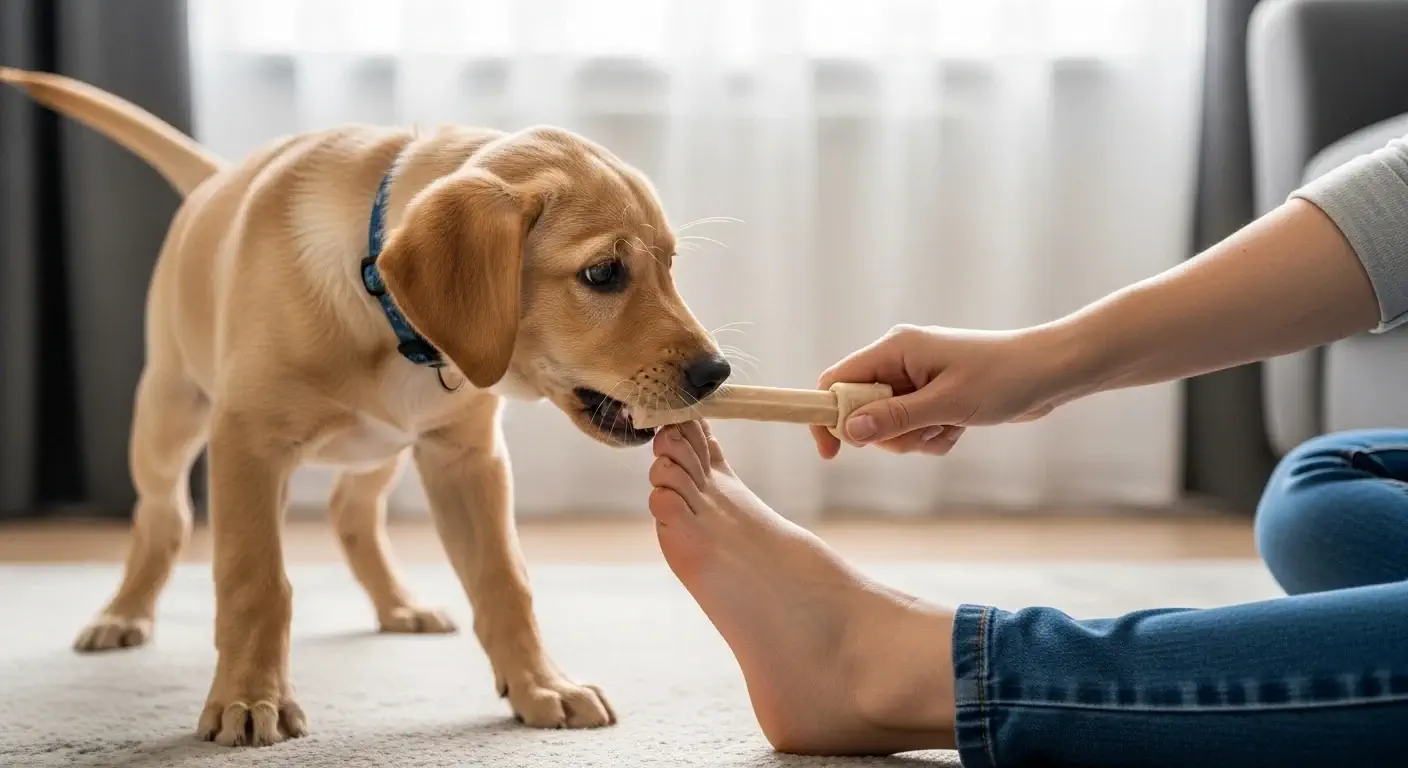
Learning how to redirect puppy biting is a game changer. The moment your puppy goes for your hand or foot, offer a chew toy instead.
Keep a toy close by during every play session. The second they lunge at your fingers, swap in the toy.
Do this consistently, and your puppy learns: hands are boring, toys are the fun stuff.
Pro tip: rotate toys regularly so they stay interesting. A bored puppy will always go back to your ankles.
Step 4: Use Positive Reinforcement
When your puppy plays gently or takes the toy instead of your hand, celebrate it. Use a treat, praise them warmly, or give them a quick pat.
Positive reinforcement is one of the most powerful tools in your training kit. You’re not just stopping a bad behavior. You’re building a new, better one.
Reward the behavior you want to see more of. It really is that simple.
Step 5: Pause Play When Biting Happens
Consistency is everything here. Every single time biting happens, play stops.
Not sometimes. Not when you’re in the mood to deal with it. Every time.
If your puppy nips, the game ends. Put them in a calm space, wait a few minutes, and then try again. Over time, they learn that biting is the thing that kills the fun.
Step 6: Be Consistent Across All Family Members
This is where a lot of families fall apart. Mom does the training perfectly. But Dad lets the puppy nibble because it’s “cute.” And the kids? Total chaos.
Every person in the household needs to follow the exact same rules. One exception undoes weeks of progress.
Have a quick family meeting. Set the rules. And hold each other accountable.
How to Stop Puppy Biting Fast (Proven Tips That Work)
Want faster results? Here are some extra tips to accelerate the process.
- Keep chew toys in every room so you can redirect instantly
- Do short training sessions, 5 to 10 minutes, multiple times a day
- Avoid accidentally encouraging biting by letting it slide “just once”
- Use a consistent cue word like “gentle” every time you interact with your pup
- Make sure your puppy gets enough exercise and mental stimulation each day
One thing I want to be honest about: there’s no truly “instant” fix. But with daily effort and consistency, most puppies show clear improvement within 2 to 3 weeks.
When we visited the dog parks in Austin, we noticed that the owners whose puppies had the best bite manners weren’t necessarily doing anything fancy. They were just consistent. Same rules, every time, from everyone.
That’s the real secret to how to stop puppy biting fast.
What to Do When Your Puppy Bites During Play
You’re mid-game, things get exciting, and chomp. There goes your hand again.
Here’s what to do in the moment:
- Stay calm. Don’t yell, jerk away dramatically, or make a big scene.
- Freeze your hand. Movement excites puppies. Stillness confuses them.
- Say your cue word (“ouch” or “no”) calmly.
- Pause the play for a moment.
- Offer a toy and resume only when your puppy is relaxed.
The key is to avoid rewarding the bite with a dramatic reaction. Keep things calm, redirect, and move on. Your puppy will start to make the connection.
How to Calm an Overexcited Puppy
Sometimes biting isn’t really about biting at all. It’s about a puppy who is just completely over the top with energy and can’t regulate themselves.
Signs your puppy is overstimulated:
- Frantic running or spinning
- Non-stop barking or whining
- Biting harder than usual
- Ignoring commands they normally follow
When you spot this, the best move is to take a full break. Move your puppy to a quiet space, let them settle down, and resist the urge to keep playing.
A simple “sit” command can work wonders. Getting them to perform a known behavior pulls their brain back into learning mode.
Also, puppies need a lot of sleep, around 16 to 18 hours a day. An overtired puppy is a bitey puppy. Building a routine with clear nap times, regular feeding, and structured play helps enormously. Check out our guide on how to keep your dog entertained while at work for ideas that double as mental stimulation.
Common Puppy Biting Training Mistakes to Avoid
Even well-meaning owners make these mistakes. Don’t let them slow your progress.
Punishing instead of training. Scolding, tapping the nose, or yelling doesn’t teach your puppy what to do. It just creates fear and confusion. Stick to positive, clear training.
Being inconsistent. Letting biting slide sometimes sends mixed signals. Your puppy can’t learn a rule that keeps changing.
Encouraging rough play. Tug of war, letting them mouth your arm, play wrestling with your hands: all of this teaches biting is okay. It isn’t.
Expecting instant results. Puppies aren’t computers. Learning takes time. If you quit after three days, you’ll never see the results.
How Long Does It Take to Train a Puppy to Stop Biting?
Most puppies show significant improvement in 2 to 4 weeks of consistent training. Full bite control, where they rarely mouth at all, can take a couple of months.
Factors that affect the timeline:
- Age: younger puppies may take longer since they’re still developing
- Breed: some breeds are mouthy by nature (looking at you, herding breeds)
- Consistency: the more consistent you are, the faster it goes
- Socialization: well-socialized puppies tend to learn bite manners faster
If you’re introducing a puppy to an older dog, that older dog can actually help teach appropriate play behavior naturally.
Be patient. Progress isn’t always linear. Some weeks will feel like two steps forward, one step back. That’s completely normal.
Bonus: Daily Puppy Training Routine for Faster Results
A simple daily routine can dramatically speed up training. Here’s a sample structure:
Morning: 10-minute play session, followed by a 5-minute training session (sit, stay, gentle). Then rest.
Afternoon: Walk or outdoor play for exercise and socialization. Redirect any biting in the moment.
Evening: Another short training session. End with calm cuddle time, not high-energy play.
Mental stimulation matters as much as physical exercise. Puzzle feeders, sniff games, and basic obedience work keep your puppy’s brain engaged and burn energy without ramping up their biting instincts.
Conclusion
Here’s the short version: puppies bite because it’s natural, but with consistent training, it absolutely stops.
Remember the big steps: stop using hands as toys, teach bite inhibition, redirect to chew toys, reward gentle behavior, pause play when biting happens, and make sure everyone in the house is on the same page.
It takes time. It takes patience. But you’ve got this.
Your puppy wants to please you. They just need you to show them how.
Stick with it, stay consistent, and in a few weeks, those sharp little teeth will be aimed at toys, not your ankles.
Frequently Asked Questions (FAQs)
1. How do I stop my puppy from biting my hands and feet quickly?
Focus on redirecting your puppy to chew toys, stopping play immediately when biting happens, and rewarding gentle behavior. Consistency and daily training sessions help speed up results.
2. Why does my puppy bite my hands and feet during play?
Puppies often bite during play due to teething, excitement, or natural exploration. It’s their way of interacting, but it needs to be guided with proper training.
3. What should I do when my puppy bites my hands while playing?
Stay calm, stop moving your hands, and pause the game. Then redirect your puppy to a toy and only continue playing when they are calm.
4. How long does it take to train a puppy to stop biting?
Most puppies improve within a few weeks, but complete bite control can take a couple of months depending on consistency, age, and training methods.
5. Is puppy biting normal or a sign of aggressive behavior?
Puppy biting is usually normal and part of development. However, if the biting is intense, frequent, or accompanied by growling or stiffness, it may need closer attention or professional guidance.