You had a rough day at work, your dog knocked over your coffee, and you snapped. You raised your voice. Maybe even said something like, “What is wrong with you?!”
And now? Your dog is sitting in the corner, ears back, tail tucked, giving you the look.
You know the one.
That sad, confused face that makes you feel like the world’s worst pet parent. The guilt hits fast, and suddenly you’re Googling “how to apologize to a dog” at 10 PM like your life depends on it.
You’re not alone. Millions of dog owners in the US have been right there with you.
Here’s the thing though: your dog doesn’t understand the word “sorry.” They’re not processing your apology like a human would. But that doesn’t mean you’re helpless.
Dogs are incredibly tuned into your tone of voice, your body language, and your behavior patterns. They feel your energy before you even open your mouth.
So yes, you can say sorry to your dog. Just not with words.
In this guide, you’ll get practical, science-backed tips on how to rebuild trust, read your dog’s signals, and actually repair your bond after a rough moment.
Do Dogs Understand Apologies?
Short Answer: No, not the word itself. But yes, they absolutely pick up on everything around it.
Dogs don’t process human language the way we do. When you walk up to your pup and say “I’m so sorry, buddy,” they’re not translating that sentence in their head. What they are doing is reading your tone, your posture, your facial expression, and your energy.
Think of it like this: your dog is less focused on what you’re saying and more focused on how you’re saying it.
Research from the University of Sussex found that dogs process emotional tone and word meaning in different parts of their brain, much like humans do. They respond more to a warm, calm voice than to the actual words being spoken.
Now, here’s a myth worth busting.
Does That “Guilty Look” Mean Your Dog Feels Bad?
Not really. That droopy-eyed, head-lowered look we call the “guilty face”? It’s mostly a response to your tone and body language, not actual guilt.
A well-known study by Dr. Alexandra Horowitz at Barnard College showed that dogs displayed “guilty” looks even when they hadn’t done anything wrong, simply because their owner thought they had.
So your dog isn’t feeling remorse. They’re reacting to your energy.
Do Dogs Hold Grudges?
Dogs live very much in the present moment. They don’t replay arguments or stew over what happened this morning. However, they do build emotional memory over time.
Repeated harsh treatment gets stored as a pattern. And that pattern shapes how safe or unsafe your dog feels around you.
So while they won’t “hold a grudge” the way your coworker might, consistent negative experiences absolutely affect their trust in you. That’s why canine communication goes both ways, and why your actions matter far more than your apologies.
Dog Behavior After Being Scolded
So you raised your voice or punished your dog. What happens next in their head?
Dogs don’t sit there analyzing the situation. Instead, their body immediately starts reacting. And if you know what to look for, those reactions tell you a lot about how your dog is feeling.
Common Signs Your Dog is Upset or Stressed
Here’s what you’ll typically notice right after scolding your dog:
- Avoiding eye contact – They look away or turn their head
- Tail tucked between legs – Classic sign of stress or fear
- Ears pinned back flat – They’re uncomfortable
- Hiding or retreating – Going under the bed or to another room
- Yawning or lip licking – These are actually stress signals, not tiredness
- Crouching low or a submissive posture – Trying to appear smaller and non-threatening
- Refusing treats – A big red flag that your dog is genuinely scared
Sound familiar? Most dog owners have seen at least a few of these.
Fear vs. Respect: Know the Difference
Here’s something really important that a lot of owners get wrong.
A dog that listens because they’re scared of you is not the same as a dog that listens because they trust you. Fear-based obedience might look like good behavior on the surface, but underneath it’s slowly chipping away at your bond.
Dogs trained through fear can develop separation anxiety triggers, become unpredictable, or shut down completely around their owners.
Respect comes from consistency, safety, and positive experiences. Fear comes from unpredictability and harsh reactions.
Why Reading These Signals Matters
When you can spot your dog’s stress signals early, you can course-correct before the damage gets deeper.
That moment your dog tucks their tail? That’s your cue to slow down, soften up, and shift your approach.
Understanding dog body language signs is honestly one of the most powerful tools you have as a pet owner. We go deeper into this in the next section, so keep reading.
Understanding Dog Body Language & Calming Signals
Ever feel like your dog is trying to tell you something but you just can’t figure out what?
They are. All the time, actually.
Dogs communicate almost entirely through body language. And within that, there’s a fascinating set of signals called calming signals. Norwegian dog trainer and author Turid Rugaas first identified these back in the 1990s, and they’ve been a game-changer in how we understand dogs ever since.
What are Calming Signals?
Calming signals are the subtle things dogs do to communicate stress, discomfort, or a desire to de-escalate a tense situation. Think of them as your dog’s way of saying “hey, can we just chill for a second?”
Here are the most common ones:
- Lip licking – Not because something tastes good. Often a stress response
- Yawning – Especially when they’re not tired. Signals anxiety or unease
- Turning their head away – Breaking eye contact to avoid confrontation
- Slow blinking – A soft, non-threatening gesture
- Sniffing the ground suddenly – Redirecting attention to calm themselves
- Shaking off – Like after a bath, but in the middle of a tense moment
- Moving in a curve – Approaching sideways instead of head-on
Why Does This Matter When Apologizing?
Here’s where it gets really practical.
If your dog is showing these signals while you’re trying to make up with them, it means they’re still stressed. Pushing through and forcing cuddles at that moment? That makes things worse, not better.
You want to wait for these signals to fade before moving closer or initiating contact.
The Misreading Problem
A lot of owners accidentally misread these signals. The yawn gets ignored. The lip lick gets dismissed. And then the owner moves in too fast, the dog gets more anxious, and suddenly the “apology moment” becomes another stressful experience for the dog.
For a deeper dive into reading what your pup is really saying, check out this guide on Decoding Dog Body Language. It’ll seriously change how you see your dog every single day.
Understanding canine communication isn’t just helpful during conflict. It’s the foundation of your entire relationship with your dog.
A Quick Real-Life Example
Imagine you just scolded your dog for chewing your favorite sneakers. You feel bad, so you walk over to pet them. They yawn, look away, and lick their lips.
Most owners think: “Aw, they’re sleepy.”
What’s actually happening: “Please give me a little space right now.”
See the difference? Once you learn to read these signals, you become a way better communicator. And a way better apologizer too.
How to Apologize to a Dog the Right Way
So what does an actual dog apology look like? Here’s exactly how to do it, step by step.
Forget getting down on your knees and dramatically saying “I’m sooooo sorry, Mr. Biscuits.” That’s for the movies.
A real apology to your dog is quieter, slower, and way more intentional. It’s all about body language, energy, and patience.
Here’s your step-by-step guide.
Step 1: Take a Breath and Calm Yourself First
Before you even approach your dog, check yourself.
Are you still tense? Still a little frustrated? Dogs read that instantly. Your tone of voice and body energy set the stage for everything that follows.
Take a few slow breaths. Relax your shoulders. Let the frustration go before you walk toward them.
Step 2: Lower Your Body
Standing tall over a stressed dog can feel threatening to them. It triggers that instinctive “big scary thing is coming” response.
Instead, get low. Sit cross-legged on the floor. Kneel down. Even crouching helps.
Lowering your body signals safety. It says “I’m not a threat right now.” It’s one of the simplest and most effective body language shifts you can make.
Step 3: Avoid Direct Eye Contact
This one surprises a lot of people.
In human culture, eye contact means honesty and connection. In dog culture? A hard, direct stare can feel like a challenge or a threat.
When apologizing, soften your gaze. Look slightly to the side. Let your eyes go relaxed and gentle. Maybe even do a slow blink, which is actually a calming signal dogs use with each other.
Step 4: Use a Soft, Calm Voice
Talk to your dog in a low, gentle tone. Not high-pitched and excited, and definitely not tense or clipped.
Something simple like “hey buddy, it’s okay” in a warm, slow voice works perfectly. You’re not explaining yourself. You’re just letting your voice carry a feeling of safety.
This is where classical conditioning quietly does its work. Your dog begins to associate that calm tone with good, safe feelings over time.
Step 5: Let the Dog Come to You
This is the big one. And it’s the hardest for most owners.
Don’t rush over and smother your dog with hugs and kisses. Even if your heart is bursting with guilt. Forcing physical affection on a stressed dog can backfire badly.
Instead, get low, stay calm, and just… wait.
Let your dog make the first move. When they sniff you, approach you, or lean in, that’s your green light. That moment of choice matters deeply to dogs. It rebuilds a sense of safety and control.
Step 6: Offer a Gentle Touch (Only If They’re Ready)
Once your dog comes to you, offer a slow, gentle pet. Behind the ears, along the back, under the chin. Places they already love.
Keep it calm. No big dramatic hugging just yet. Think of it as a quiet handshake, not a bear hug.
Studies show that gentle physical touch can actually boost oxytocin levels in dogs, the same “bonding hormone” humans experience. So a soft, unhurried pet goes a long way in signaling that everything is okay between you two.
Step 7: Follow Up With Something Positive
After the initial reconnection, do something your dog genuinely enjoys. A short walk, a little playtime, or even just sitting together quietly.
This isn’t about bribing them. It’s about layering positive experiences on top of a stressful moment. You’re helping their brain begin to associate you with good feelings again.
That’s the real apology. Not the word “sorry.” But the action that follows it.
How to Apologize to Your Dog After Yelling
Raised your voice and now your dog is giving you the silent treatment? Here’s what to do right now.
It happens to the best of us. The dog barked for the tenth time, knocked over the trash again, or just picked the absolute worst moment to act up. You snapped. You yelled.
And now the guilt is real.
First, take a breath. You’re not a monster. But you do need to handle the next few minutes carefully.
Immediate Steps After Yelling at Your Dog
1. Stop and go quiet immediately.
The moment you realize you’ve gone too far, just stop. No more loud voice, no more tense energy. Silence is actually really powerful here.
2. Give them a little space.
Don’t rush straight into apology mode. Your dog needs a moment to settle, and honestly, so do you. Even two or three minutes of calm distance helps.
3. Soften everything.
Your voice, your face, your posture. Come back down to neutral before you approach them.
4. Reintroduce yourself calmly.
Walk over slowly, get low, speak gently. Use the steps from the previous section as your guide.
One Big Mistake to Avoid
A lot of owners swing from yelling straight into super excited, over-the-top affection mode. Like they’re trying to erase what just happened with a burst of energy.
“WHO’S A GOOD BOY, YES YOU ARE, COME HERE, COME HERE!”
This actually confuses your dog. That sudden high-pitched excitement after a scary moment sends mixed signals. It can even raise their anxiety instead of lowering it.
Keep the energy calm, warm, and steady. Think comfort, not celebration.
Your tone of voice after yelling is everything. Soft and slow wins every single time.
What to Do If Your Dog is Scared of You After Punishment
Your dog is flinching, hiding, or won’t come near you. Here’s how to handle this carefully.
This one stings. Because when your dog is genuinely scared of you, it’s a sign the trust has taken a real hit. But it’s not the end of the road. Not even close.
The key is knowing what not to do just as much as knowing what to do.
Signs Your Dog is Actually Scared of You
Watch for these behaviors after a punishment:
- Flinching when you reach toward them
- Hiding under furniture or in another room
- Crawling low or showing a submissive posture when you approach
- Refusing food from your hand
- Avoiding eye contact completely and consistently
- Trembling or panting without physical cause
If you’re seeing two or more of these together, your dog isn’t just a little shaken. They’re genuinely fearful. That needs a thoughtful, patient response.
Step-by-Step: Rebuilding Safety After Punishment
Step 1: Give them real space.
Don’t hover. Don’t follow them to their hiding spot. Let them have their corner, their safe place. Respect that boundary completely.
Step 2: Go about your normal routine.
Move around the house calmly. Do regular things. Cook dinner, watch TV, fold laundry. Your calm, predictable presence starts to signal that the scary moment has passed.
Step 3: Get on their level, but don’t reach out yet.
Sit on the floor near them, not right next to them. Just exist in their space without any pressure or expectation. Let them observe you being calm and safe.
Step 4: Reintroduce positive interactions slowly.
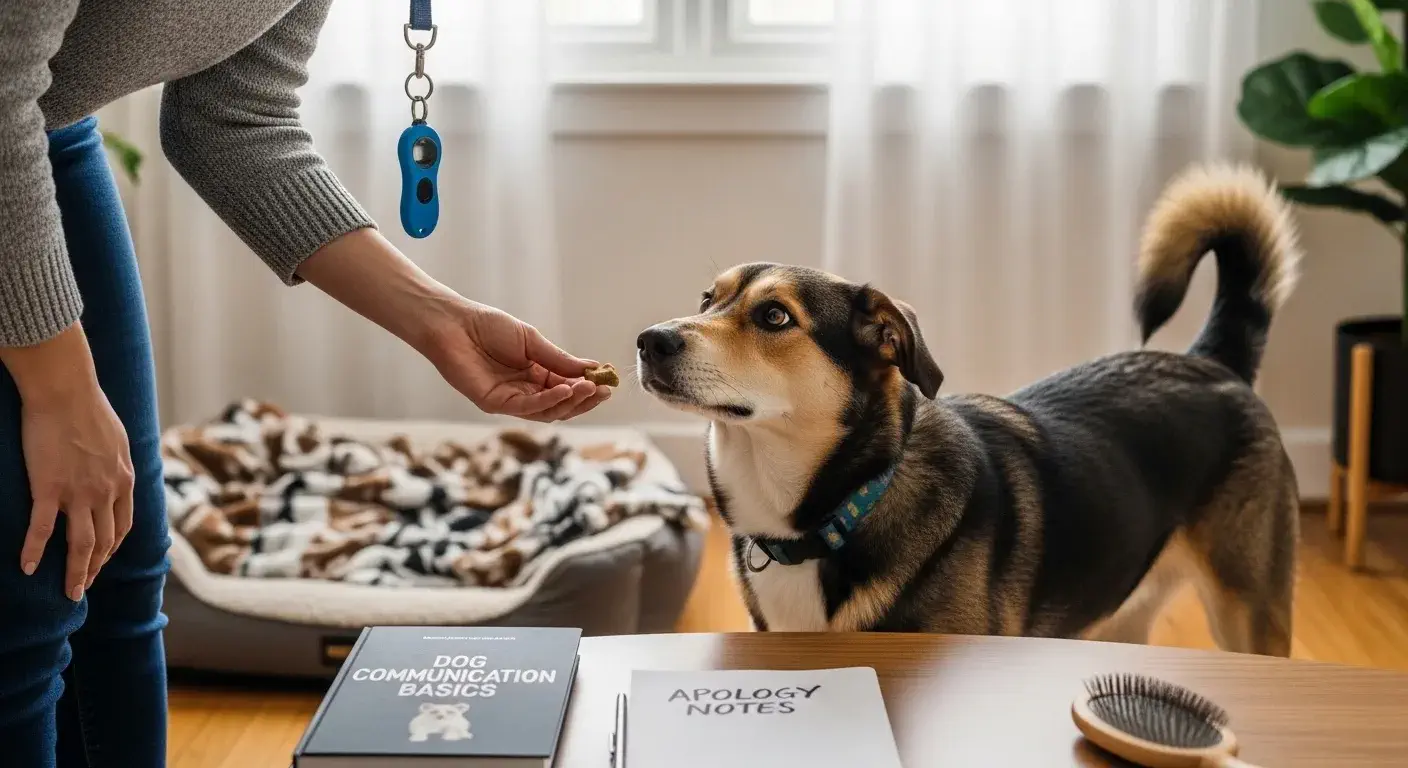
After some time, try offering a treat gently. Don’t push it toward them. Place it on the floor nearby and back off. Let them choose to take it.
This small act of giving them a choice is huge for rebuilding confidence.
Step 5: Use your voice as a tool.
Talk softly while you’re in the room. Not directly at them, just gentle background chatter. Your calm tone of voice becomes a reassuring signal over time.
The Most Important Thing Here
Patience. Not hours of patience. Sometimes days or even weeks of patience, depending on how sensitive your dog is and what happened.
Never force interaction. Never drag them out of their hiding spot. Never flood them with affection they didn’t ask for.
Trust rebuilt through pressure isn’t real trust. It’s just compliance wrapped in anxiety.
Real recovery happens slowly, gently, and completely on your dog’s timeline.
How to Regain Your Dog’s Trust
One apology won’t fix everything. Here’s how to actually rebuild trust over time.
Here’s the honest truth that most people don’t want to hear.
You can’t apologize your way back into your dog’s good books with a single soft voice moment and a treat. Real trust isn’t built in one afternoon. It’s built through dozens, hundreds of small consistent moments that tell your dog the same thing over and over again.
You are safe with me.
That’s the message. And here’s how you deliver it, consistently.
Practical Trust-Building Exercises
1. Hand-Feed Their Meals
This one is incredibly powerful and wildly underused.
Instead of putting the bowl down and walking away, sit with your dog and hand-feed their regular meals piece by piece. It takes longer, sure. But every single piece of food taken gently from your hand is a tiny deposit into the trust bank.
It directly connects your presence with something deeply positive. Food is comfort. You become comfort.
2. Short, Positive Training Sessions
Keep them to five or ten minutes maximum. Pick simple commands your dog already knows, like sit or paw.
Ask, they respond, you reward. That’s it.
These short wins do something really important. They create a rhythm of success between you and your dog. Your dog starts to see interactions with you as predictable and rewarding rather than scary and unpredictable.
Positive reinforcement at this stage isn’t just training. It’s therapy for the relationship.
3. Gentle Play Sessions
Grab their favorite toy. Get on the floor. Keep the energy calm and fun, not wild and chaotic.
Even ten minutes of gentle tug or a slow game of fetch in the backyard works wonders. Play builds joy. Joy builds connection. Connection rebuilds trust.
4. Go for Walks Together
Walks are honestly one of the most underrated bonding tools available to dog owners.
Side by side movement, shared experiences, new smells, a little adventure. It shifts the energy between you and your dog in a really natural way. Many owners report that a good long walk after a tense moment helps reset the relationship faster than almost anything else.
Routine and Predictability are Everything
Dogs thrive on knowing what to expect. Feed them at the same time. Walk them at the same time. Play at the same time.
When your dog can predict your behavior, their nervous system relaxes. And a relaxed dog is a dog that trusts their environment, and trusts you.
This is especially important if your dog already shows separation anxiety triggers. Consistent routine sends a powerful message of safety that no single apology ever could.
Consistency Over Grand Gestures
Forget the big dramatic moments. Your dog doesn’t need a grand gesture.
They need you to be calm today. And tomorrow. And the day after that.
That’s what reconciliation behaviors actually look like in real life. Not a single moment of making up, but a string of boring, beautiful, consistent good days.
Think of trust like a jar of marbles. Every gentle interaction, every calm voice, every patient moment adds a marble. Every harsh reaction takes one out.
Your job is simple: keep adding marbles.
Positive Reinforcement: The Best “Apology Language”
What’s the most powerful way to say sorry to your dog? Reward them for being brave enough to trust you again.
If dogs had a love language, it would be positive reinforcement. Hands down.
And the beautiful thing is, it’s incredibly simple. You reward the behavior you want to see more of. That’s literally it.
No complicated techniques. No special equipment. Just you, your dog, and a whole lot of consistency.
How Positive Reinforcement Works
When your dog does something good, or even just approaches you calmly after a tense moment, you mark that moment with something they love.
A small treat. A warm “good boy.” A gentle scratch behind the ears. A quick game with their favorite toy.
That positive moment gets stored. Their brain essentially bookmarks it and says “hey, that felt great, let’s do that again.”
Over time, you become associated with those great feelings. That’s classical conditioning working quietly in the background, turning your presence into something your dog genuinely looks forward to.
Why Punishment Pulls You Apart
Here’s the flip side.
Punishment, especially physical or aggressive punishment, does the opposite. Instead of building a bridge between you and your dog, it builds a wall.
According to the American Veterinary Society of Animal Behavior, punishment-based training increases fear, anxiety, and aggression in dogs. It doesn’t teach them what to do. It just teaches them to be afraid of what happens when they get it wrong.
That’s not a relationship. That’s survival mode.
Practical Ways to Use Positive Reinforcement as an Apology
- Treats: Small, high-value treats work best right after a tense moment. Think tiny pieces of chicken, cheese, or their absolute favorite snack
- Verbal praise: A calm, warm “good girl” or “that’s my boy” in a soft voice goes a long way
- Toys: Bringing out a beloved toy signals playtime and safety all at once
- Physical affection: Once they’re relaxed and approaching you willingly, gentle pets and scratches are incredibly reassuring
The Real Message Here
Positive reinforcement isn’t just a training tool. In the context of an apology, it’s a promise.
It says: I see you. I’m going to do better. And every good moment between us from here is proof of that.
That’s the apology your dog actually understands.
How Dogs Show Forgiveness
Wondering if your dog has actually forgiven you? Here’s what to look for.
This is honestly the best part of the whole process.
Because dogs? They are remarkably generous forgivers. Way more generous than most humans, if we’re being honest. They don’t carry resentment like we do. They don’t bring up old arguments. They don’t give you the cold shoulder for three days straight.
When the storm passes, they’re ready to move forward. And they’ll show you clearly when they are.
Signs Your Dog Has Forgiven You
Watch for these beautiful little signals:
- Tail wagging when you enter the room, especially that full-body wiggle
- Coming close to you on their own, without being called
- Relaxed, loose posture instead of that stiff, tucked-in tension
- Making eye contact softly and comfortably again
- Asking for attention by nudging your hand or dropping a toy at your feet
- Falling asleep near you or leaning against you
- Eating normally from your hand or their bowl without hesitation
Each of these is your dog quietly saying “we’re good.”
Dogs Forgive Fast, But They Remember Patterns
Here’s the important nuance though.
While dogs live in the present and forgive individual moments quickly, they absolutely track patterns over time. Research around oxytocin levels in dogs shows that positive interactions genuinely strengthen the emotional bond between dogs and their owners at a biological level.
The opposite is also true. Repeated harsh treatment gets wired in, even if each individual incident is “forgiven.”
So yes, celebrate when you see that tail wagging again. That loose, happy trot back toward you is a genuine gift.
Just make sure you keep earning it, every single day.
How to Make Your Dog Trust You Again After Hitting
This is a hard section to write. But it’s an important one.
First, no judgment here. People make mistakes. Sometimes fear, frustration, or a moment of total overwhelm leads to something they deeply regret.
But let’s be completely clear about one thing.
Physical punishment damages a dog’s trust in a way that goes deeper than yelling or scolding ever could. It triggers a primal fear response. And for some dogs, especially those already carrying trauma, it can have lasting effects on their behavior and mental wellbeing.
If this happened, the most important thing you can do right now is commit to making sure it never happens again. Full stop.
Steps to Rebuild Trust After Physical Punishment
Step 1: Stop all punishment immediately.
Not just physical punishment. Harsh verbal corrections, intimidation, looming over them. All of it stops now. Your dog needs to experience a completely different version of you going forward.
Step 2: Create a calm, safe environment.
Keep the house calm and predictable. Lower your voice across the board. Move slowly and deliberately around your dog. Let every interaction carry the message: this is a safe place now.
Step 3: Don’t force any interaction.
Your dog may avoid you for a while. Maybe a long while. That’s okay and completely understandable. Forcing contact will only deepen the fear. Let them set the pace entirely.
Step 4: Reintroduce yourself through positive experiences.
Place treats near yourself without making a big deal of it. Sit on the floor and read a book. Just exist calmly in their space without any agenda or expectation.
Over time, curiosity tends to win over fear. But only if the environment consistently feels safe.
Step 5: Consider professional support.
If your dog is showing prolonged fear responses, working with a certified professional dog trainer or animal behaviorist is genuinely worth it. They can guide both you and your dog through a structured recovery process.
The American Society for the Prevention of Cruelty to Animals (ASPCA) and the Certification Council for Professional Dog Trainers (CCPDT) both have resources to help you find qualified, force-free professionals near you.
The Bigger Picture
Recovery from this kind of breach of trust is slow. It requires real patience, real consistency, and real commitment to changing your approach permanently.
But dogs are resilient. With time, gentleness, and unwavering positive reinforcement, many dogs do come back. They do trust again.
Give them every reason to.
Mistakes to Avoid When Apologizing to a Dog
Trying to make things right but accidentally making them worse? Here’s what to stop doing.
Good intentions aren’t always enough. Some of the most common “apology” moves that owners try actually backfire pretty badly with dogs.
Here’s what to avoid:
The Most Common Apology Mistakes
1. Yelling again immediately after.
You calm down, things feel better, then something else goes wrong and you snap again. This is probably the most damaging pattern of all. Inconsistency teaches your dog that calm moments can’t be trusted.
2. Forcing affection.
Grabbing your dog for hugs they didn’t ask for right after a tense moment? That’s for you, not them. It often increases stress rather than relieving it.
3. Switching to an overly excited tone too fast.
Going from tense and loud to high-pitched and hyper is confusing and unsettling for dogs. Keep the energy smooth and gradual.
4. Ignoring your dog’s body language.
If they’re still yawning, lip licking, or turning away, they’re not ready yet. Pushing through those signals is a mistake every time.
5. Being inconsistent overall.
One great apology session followed by days of unpredictable behavior means nothing. Dogs need patterns, not performances.
6. Using treats to bribe instead of bond.
Frantically shoving treats at a scared dog feels desperate and pushy. Offer gently, back off, and let them choose.
Avoiding these mistakes is honestly just as important as doing everything else right.
Final Thoughts
At the end of the day, your dog doesn’t need a perfect owner. They need a consistent, caring one.
Dogs are remarkably forgiving creatures. They don’t hold onto anger the way we do. They don’t replay the argument on a loop at 2 AM. They just want to feel safe, loved, and connected to their favorite human.
Which is you, by the way. Even on your worst days.
Knowing how to say sorry to your dog isn’t really about finding the magic words. It’s about understanding that every calm interaction, every gentle voice, every patient moment is its own kind of apology.
Actions over words. Always.
So the next time things go sideways, and they will because life is messy and dogs are chaotic little creatures, you’ll know exactly what to do.
Breathe. Slow down. Get low. Let them come to you.
And then just keep showing up, day after day, as the safe and steady person your dog already believes you can be.
They forgave you before you even started reading this article. Now go prove them right.
Frequently Asked Questions (FAQs)
1. Do dogs understand when you say sorry?
Dogs don’t understand the word “sorry” itself. But they absolutely pick up on your tone of voice, your body language, and the energy you bring into the room. A calm, soft approach communicates far more than any word ever could.
2. How long does it take for a dog to forgive you?
Most dogs move on from a single incident pretty quickly, sometimes within minutes if the situation is handled well. However, rebuilding deeper trust after repeated harsh treatment can take days, weeks, or even longer. It really depends on your dog’s personality and the consistency of your behavior going forward.
3. Can dogs feel guilt or hold grudges?
Dogs don’t experience guilt the way humans do. That classic “guilty look” is almost always a response to your tense body language or tone, not actual remorse. And while dogs don’t hold grudges in the human sense, they do build emotional memory over time. Repeated negative experiences absolutely shape how they feel around you.
4. What are signs your dog forgives you?
Look for tail wagging, approaching you on their own, relaxed and loose body posture, soft eye contact, leaning against you, or dropping a toy at your feet. These are all your dog’s way of saying “we’re good, let’s move on.”
5. What should I do if my dog is scared of me?
Give them space first. Don’t force interaction or follow them to their hiding spot. Move calmly around the house, get low when you’re near them, and slowly reintroduce positive experiences using treats, gentle play, and a consistently soft tone of voice. Patience is everything here.
6. Is yelling at a dog harmful?
Yes, frequent yelling can cause genuine fear and confusion in dogs. It damages the bond between you, makes training far less effective, and can even trigger separation anxiety over time. An occasional raised voice won’t ruin your relationship, but a pattern of it absolutely will.