It’s a crisp Tuesday morning in suburban Ohio. You’ve got your coffee, your shoes are on, and your dog is doing that excited spin by the front door.
But there’s a pause. A worry. Is it safe to take him out today?
If your dog has lost their vision, that pause can feel heavy. Trust me, a lot of pet parents feel exactly that.
Here’s the truth though: blind dogs can absolutely go on walks. Not just “safe” walks, but genuinely happy, tail-wagging, nose-to-the-ground joyful walks.
Dogs don’t experience the world the way we do. They don’t need their eyes to feel free. They need smells, sounds, and you right there beside them.
In this guide, you’ll learn everything about how to walk a blind dog without stress or confusion. We’re talking the right gear, training tips, verbal cues, safe routes, and how to build your pup’s confidence one small step at a time.
Whether your dog was born blind or lost sight recently, this guide has you covered. So take a breath, grab that leash, and let’s figure this out together.
Can Blind Dogs Go for Walks?
Short answer? Absolutely yes.
In fact, walks aren’t just okay for blind dogs. They’re genuinely important for their health and happiness.
A lot of pet owners assume that once a dog loses their vision, outdoor life becomes too risky. That’s a myth worth busting right now.
So What Makes Walks Good for Blind Dogs?
Walks offer three big wins:
- Mental stimulation: Sniffing a fire hydrant or a patch of grass is like reading the morning newspaper for dogs. Smell does all the heavy lifting.
- Physical health: Muscles, joints, and heart health don’t care if a dog can see or not. Movement matters.
- Confidence building: Every successful walk tells your dog, “I’ve got this.” That feeling stacks up over time.
According to the American Kennel Club, dogs rely heavily on their nose and ears to understand the world around them. Vision is actually lower on their sensory priority list than most people think.
Think of it this way: a blind dog on a familiar trail is like a person walking through their own home in the dark. They just know where things are.
Blind doesn’t mean helpless. It just means your dog navigates differently, and with your help, they can do it beautifully.
Understanding Your Blind Dog’s World
How does a blind dog actually experience a walk?
Way better than you’d expect, honestly.
Dogs have about 300 million olfactory receptors in their nose. Humans have around 6 million. So while you’re noticing the neighbor’s new lawn mower, your dog is picking up the scent trail of every squirrel, dog, and pizza delivery guy who passed by in the last 48 hours.
Pretty wild, right?
Dogs Build Mental Maps
Here’s something that’ll change how you think about your blind pup.
Dogs create what animal behaviorists call sensory maps. They memorize spaces using smell, sound, and touch. Your backyard, your block, your usual walking route… your dog has likely mapped all of it already.
This is why routine is everything for a visually impaired dog. Familiar paths feel safe. New environments feel unpredictable.
A Reddit thread in r/dogs once described it perfectly: “My blind beagle walks our neighborhood loop like she owns it. New routes though? Total chaos.”
That’s not unusual at all.
Why Sudden Changes Throw Them Off
Imagine someone rearranged your furniture without telling you. Now imagine navigating that in the dark.
That’s what an unexpected route change or new environment feels like for your dog. It’s not stubbornness. It’s genuine confusion.
Understanding this helps you become a better guide. Which leads us perfectly into preparing for that very first walk together.
Preparing for the First Walk
Feeling nervous before your blind dog’s first walk? That’s completely normal.
But here’s the thing: a little preparation goes a long way. Like, a really long way.
Think of it like planning a road trip with a friend who’s never left their hometown. You wouldn’t just throw them on the highway. You’d ease them into it.
Same idea here.
Choose the Right Time
Timing matters more than most people realize.
Early mornings or late evenings are ideal. Less traffic, fewer dogs barking, quieter streets overall. Sensory overload is a real challenge for blind dogs, so a calm environment sets them up for success right from the start.
Avoid busy weekend afternoons when the whole neighborhood is out with kids, bikes, and loud music. That’s a lot for any dog, let alone one navigating without sight.
Use the Right Gear
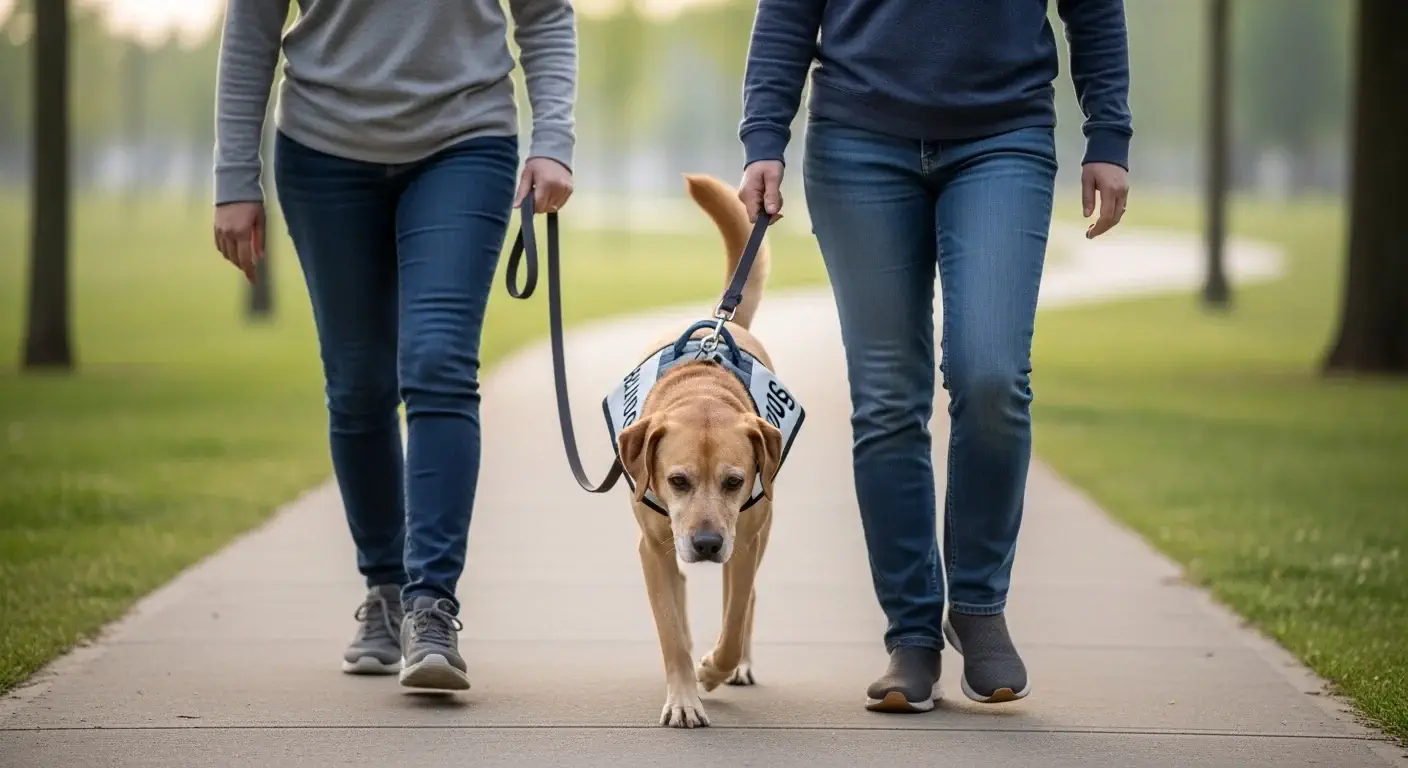
Ditch the collar for walks. A well-fitted harness is your best friend here.
Harnesses distribute pressure evenly and give you better control without putting strain on your dog’s neck. This is especially important when you need to gently redirect them away from obstacles.
A few gear tips:
- Avoid retractable leashes completely. They give too much unpredictable slack.
- Use a standard 4 to 6 foot leash for consistent, close guidance.
- Consider a halo harness, designed specifically for blind dogs. It has a bumper ring that gently warns them before they bump into something. You can find good options on Chewy or Amazon.
Start Indoors First
Before hitting the sidewalk, practice inside your home.
Walk your dog through the hallway. Use simple verbal cues like “step” near the doorstep or “slow” near furniture. Let them get comfortable responding to your voice while on leash in a familiar, safe space.
This indoor practice builds a communication rhythm between you two. By the time you head outside, your dog already knows what your cues mean. That’s a huge confidence boost for both of you.
If you’re also working on general leash manners, check out this helpful guide on how to walk a golden retriever for some foundational techniques that apply across breeds.
Stay Calm and Confident
This one is simple but so important.
Dogs are emotional mirrors. If you’re anxious and tense on the leash, your dog feels that energy and gets anxious too. If you’re calm and steady, they take that as a cue that everything is okay.
Take a breath before you clip that leash. Relax your grip. Walk like you’ve done this a hundred times, even if today is the very first time.
Your confidence is literally your dog’s compass.
Essential Blind Dog Walking Techniques
What’s the actual best way to walk a dog that cannot see?
Think of yourself as a GPS with a heartbeat.
Your job isn’t to drag your dog along or protect them from every blade of grass. It’s to guide them gently, communicate clearly, and let them experience the world on their own four paws.
Here’s how to do that well.
Use Verbal Cues
Your voice is your dog’s most powerful navigation tool on a walk.
Start building a simple vocabulary your dog learns to trust. Some essential cues:
- “Step” – there’s a curb, stair, or uneven ground ahead
- “Slow” – reduce pace, something tricky is coming
- “Stop” – freeze completely
- “Left” / “Right” – directional guidance around obstacles
- “Good” – you’re doing amazing, keep going
Say cues before the obstacle, not during. Give your dog a second to process and respond. It’s like a turn-by-turn navigation system. Nobody likes when GPS announces a turn after you’ve already missed it.
Gentle Leash Guidance
Light, steady pressure is your best communication tool through the leash.
No sudden yanks. No sharp pulls. Those feel alarming to a dog who can’t see what’s happening.
Instead, use subtle directional pressure. A gentle left nudge means move left. A slight backward tension means slow down. Keep it smooth and predictable.
Over time your dog will read these micro-signals almost automatically. It becomes a quiet conversation between you two.
Walk Slightly Ahead or Beside
Position matters more than most people think.
Walking slightly ahead or right beside your dog lets you act as a natural guide. You spot the obstacle first and communicate before your dog reaches it.
Avoid walking behind your dog during early walks. Without visual feedback, they need you leading the way, not following.
Keep a Consistent Pace
Predictability builds trust faster than almost anything else.
A steady, even pace tells your blind dog: “Everything is under control. I’ve got you.” Sudden speed changes or erratic stopping and starting creates confusion and anxiety.
Think calm river, not roller coaster.
Once your dog locks into your rhythm, you’ll notice them walking with more confidence and less hesitation. Their head comes up, their tail relaxes, their whole body language shifts.
That moment right there? Genuinely one of the best things you’ll witness as a pet parent.
It also helps to understand your dog’s body language so you can read how they’re feeling throughout the walk and adjust your pace or cues accordingly.
Leash Training for Blind Dogs
How do you actually teach a blind dog to walk on a leash comfortably?
The same way you’d teach anything new to any dog. Slowly, patiently, and with a whole lot of treats.
The difference with blind dogs is that trust-building takes center stage. Every session is less about “training” and more about saying, “Hey, I’ve got you. We’re safe.”
Start with Short Sessions
Don’t aim for a 30-minute walk right out of the gate.
Start with 5 to 10 minute leash sessions inside your home or backyard. Familiar smells and sounds make the environment feel manageable. Short sessions also prevent mental fatigue, which is very real for dogs processing the world without sight.
As your dog gets comfortable, gradually increase duration. Let them set the pace of progress, not your schedule.
Reward-Based Training
Treats are your secret weapon here.
Every time your dog responds correctly to a cue, follows your leash guidance, or simply stays calm in a new situation, reward them immediately. That immediate connection between behavior and reward is what builds confidence fast.
Use high-value treats your dog goes crazy for. Think small pieces of chicken, cheese, or their favorite training snacks.
Pair treats with verbal praise too. A warm “Yes! Good boy!” goes a long way. Dogs pick up on tone beautifully, so keep your praise voice genuinely happy, not robotic.
If you’re unsure about the best training approach for your specific dog, it might be worth reading up on how to choose the right dog trainer who has experience with special needs pets.
Introduce New Sounds Gradually
The outside world is loud and unpredictable.
Traffic, skateboards, lawnmowers, kids screaming at the park. For a dog relying entirely on hearing, that’s a LOT of incoming information.
Introduce your dog to these sounds gradually. Start in quieter areas and slowly work toward busier environments over several weeks. Let them sniff, pause, and process without rushing them along.
If your dog freezes or shows signs of stress, don’t push forward. Just wait calmly, offer reassurance, and try again another day.
Avoid Overcorrection
This one is really important.
If your blind dog pulls toward something, bumps into a low hedge, or gets momentarily confused, resist the urge to correct them harshly.
Harsh corrections create fear. Fear kills confidence. And a fearful blind dog is a dog that stops wanting to go outside altogether.
Gentle redirection plus calm reassurance is always the move. Always.
Remember: your dog is working incredibly hard to navigate a world they can’t see. A little grace goes a long way.
Important Commands for Safe Walks
What commands does a blind dog actually need to walk safely?
Not many, honestly. But the ones they need, they need to know really well.
Think quality over quantity. A dog that responds reliably to five commands is way safer than a dog that half-knows fifteen.
Basic Safety Commands
These three are non-negotiable. Teach them first, practice them most.
- “Stop” – Freeze immediately. Use this near roads, stairs, or any sudden hazard.
- “Step” – There’s a change in ground level coming. A curb, a stair, a dip in the sidewalk.
- “Wait” – Pause and hold position. Different from stop. More of a “hang tight for a second” signal.
Practice these indoors until your dog responds consistently before testing them outside.
Directional Commands
Once the basics are solid, add directional guidance.
- “Left” – move or turn left
- “Right” – move or turn right
These feel fancy but they’re genuinely useful when navigating around poles, parked bikes, or other dogs on narrow sidewalks.
Keep hand signals out of it obviously. Voice only.
Reassurance Words
This category doesn’t get nearly enough credit.
Words like “good,” “you’re okay,” and “easy” aren’t just fluff. They’re active communication. They tell your dog the environment is safe and you’re still right there beside them.
Here’s the key thing most people miss though.
Tone matters more than volume.
A loud “STOP” in a panicked voice triggers anxiety. A firm, calm “stop” in a steady voice triggers trust. Your dog reads your emotional state through how you speak, not just what you say.
Keep your voice low, steady, and confident during walks. Save the excited baby talk for cuddle time at home.
Also worth noting: consistency is everything with commands. If “step” means curb today, it needs to mean curb every single day. Switching words mid-training confuses your dog and slows progress significantly.
Practice commands the same way every time, with the same tone, same word, same context. Your blind dog will surprise you with how quickly they lock it all in.
Choosing Safe Walking Routes
Does it matter where you walk a blind dog?
More than most people realize, yes.
The right route isn’t just about convenience for you. It’s about creating a space where your dog feels safe, confident, and genuinely happy to be outside.
Think of walking routes as your dog’s memory playground. The more familiar a path, the more freedom your dog feels on it.
Stick to Familiar Paths First
Your usual neighborhood loop? Perfect starting point.
Your dog likely already has a mental map of that route built from previous walks. Familiar smells, familiar sounds, familiar textures under their paws. All of that adds up to comfort.
Save new routes for later, after your dog has rebuilt confidence on familiar ground.
Avoid Crowded or Noisy Areas
Busy parks, farmer’s markets, school pickup zones. These are sensory chaos for a blind dog.
Too many unpredictable sounds and smells from too many directions creates genuine overwhelm. Start with quieter streets and calmer environments until your dog is consistently relaxed on walks.
Stick to Even Surfaces
Smooth sidewalks and flat paths are your best friends early on.
Avoid routes with lots of:
- Broken or uneven pavement
- Gravel or loose ground
- Steep hills or sudden drops
- Construction zones with unpredictable sounds and debris
Even surfaces let your dog focus on following your cues instead of managing their footing constantly.
Gradually Introduce New Routes
Once your dog is thriving on familiar paths, slowly expand their world.
Introduce one new element at a time. A slightly different street. A new park on a quiet morning. A short detour through an unfamiliar block.
Go slow. Let them sniff and explore. Celebrate the wins.
Each new route successfully navigated adds another layer to their mental map and another notch of confidence in their belt.
Helping Your Dog Navigate Obstacles
What happens when your blind dog encounters something in the way?
You guide them through it. Calmly, clearly, and without making it a big dramatic deal.
Obstacles are inevitable on any walk. The goal isn’t to avoid every single one. It’s to help your dog handle them with confidence.
Give a Verbal Heads Up First
Always announce an obstacle before your dog reaches it.
A simple “slow” or “step” a few feet before the obstacle gives your dog time to process and prepare. Think of it like a yellow traffic light. It’s a warning, not a sudden stop.
Never wait until your dog is already bumping into something to react. That feels startling and erodes trust quickly.
Slow Down in Tricky Areas
Cut your pace significantly near:
- Curbs and road crossings
- Staircases and ramps
- Narrow pathways between parked cars
- Areas with low hanging branches or signs
Slowing down gives both of you more reaction time. It also signals to your dog that something requires extra attention ahead.
Guide Around Poles and Tight Spaces
Use gentle leash pressure to steer around obstacles.
A soft leftward nudge before a pole, a slight backward tension near a tight gap. Keep movements smooth and deliberate. No sudden jerks or sharp redirections.
If your dog hesitates near an obstacle, don’t force them forward. Let them stand still, sniff around, and gather information. Dogs process obstacles through smell before anything else. Give them that moment.
Let Them Sniff and Explore Safely
Sniffing IS navigating for a blind dog.
When your dog pauses to sniff a bench, a hedge, or a patch of sidewalk, that’s not them being distracted. That’s them actively reading their environment and updating their mental map.
Let it happen. Encourage it even.
A dog that sniffs confidently is a dog that feels safe. And a dog that feels safe is a dog that walks happily.
Learning to understand your dog’s body language will help you recognize when they’re exploring comfortably versus when they’re genuinely stressed near an obstacle.
Building Confidence in Blind Dogs
How do you help a blind dog go from nervous to genuinely excited about walks?
One small win at a time.
Confidence isn’t something you can rush or force. It grows slowly, through repeated positive experiences and a whole lot of patience from you.
The good news? It absolutely grows. Every single time.
Gradual Exposure
Start small and build slowly.
Don’t jump from backyard practice to a busy neighborhood street in one day. That’s like teaching someone to swim by throwing them in the deep end.
Week one: front yard or driveway. Week two: quiet street near home. Week three: slightly longer familiar route.
Each successful outing tells your dog’s nervous system: “This is okay. I survived. Actually, that was kind of great.”
Stack enough of those experiences and you’ve got a confident dog.
Positive Reinforcement
Celebrate everything. Seriously, everything.
Your dog walked past a trash can without flinching? Treat. They responded perfectly to a “stop” command near a curb? Huge praise. They sniffed a new patch of grass with a wagging tail? Party time.
Small wins feel enormous to a dog learning to trust the world again. Your enthusiasm tells them their efforts are working.
According to the American Veterinary Society of Animal Behavior, positive reinforcement is the most effective and humane training method for dogs, especially those dealing with fear or anxiety. It builds lasting behavioral change without damaging trust.
Consistent Routine
Routine is genuinely therapeutic for blind dogs.
Same walk time every day. Same starting route. Same verbal cues in the same order. Predictability creates safety, and safety creates confidence.
Think about it from your dog’s perspective. When everything feels familiar and expected, there’s nothing left to be anxious about.
Even if life gets busy, try to keep walk times consistent. A dog that knows their 7am walk is coming feels settled all morning. It’s a small thing that makes a big difference.
If your dog struggles with anxiety during alone time between walks too, it might help to read about ways to keep your dog entertained while at work. A mentally stimulated dog is generally a calmer, more confident dog overall.
Interactive Games
Confidence building doesn’t stop when the walk ends.
Scent games are absolutely brilliant for blind dogs. Hide treats around the house or yard and let your dog sniff them out. This sharpens their nose, exercises their brain, and reminds them that their senses are powerful and reliable.
Sound toys, puzzle feeders, and snuffle mats are also fantastic tools. They keep your dog mentally engaged and reinforce the idea that exploring is fun, not scary.
A dog that plays confidently at home almost always walks more confidently outside too. The two go hand in hand.
Celebrate the Bigger Milestones Too
First time your blind dog navigated a curb perfectly on their own?
That deserves a genuine celebration. Maybe even a little happy dance from you. Your dog won’t judge. They’ll just be thrilled by your excited energy.
Progress with blind dogs can feel slow some days. But when you look back after a few months and see how far your pup has come, it’s honestly one of the most rewarding things you’ll experience as a pet parent.
Common Mistakes to Avoid
What do most people get wrong when walking a blind dog?
Honestly, most mistakes come from a good place. Too much worry, too much rushing, too much wanting to help. But a few habits can actually slow your dog’s progress without you even realizing it.
Here’s what to watch out for.
Pulling the Leash
The number one mistake, hands down.
Yanking a blind dog forward when they hesitate feels like being grabbed in the dark. It’s startling and scary. Always use gentle guidance, never force.
Changing Routes Too Often
Variety might be the spice of life for you, but for your blind dog it’s just stress.
Switching up routes constantly prevents your dog from building that mental map we talked about earlier. Stick to familiar paths until your dog is genuinely thriving, then introduce changes slowly.
Skipping Verbal Cues
Some owners rely purely on leash pressure and forget to talk to their dog during walks.
Big mistake. Your voice is your dog’s primary navigation system outside. Use it consistently, every single walk, no exceptions.
Rushing the Process
Pushing your dog to walk further, faster, or in new environments before they’re ready backfires every time.
Progress that feels slow is still progress. Honor your dog’s pace completely.
Ignoring Body Language
A tucked tail, flattened ears, or stiff posture are your dog saying “I’m not okay right now.”
Learn to read those signals and respond by slowing down, reassuring, or heading home if needed. Understanding your dog’s body language is genuinely one of the most valuable skills you can develop as a pet owner.
Signs Your Blind Dog Is Comfortable on Walks
How do you actually know if your blind dog is enjoying their walk?
They’ll tell you. Just not with words.
Dogs communicate comfort and happiness through their body constantly. Once you know what to look for, it becomes pretty obvious when your pup is having a genuinely good time out there.
Green Light Signals to Watch For
These are the signs that tell you everything is going well:
- Relaxed body posture: Loose muscles, easy stride, no stiffness or crouching low
- Wagging tail: The classic happy signal. Hard to fake, easy to spot.
- Confident sniffing: Nose actively working, head moving freely, exploring without hesitation
- Responding to commands smoothly: Quick, calm reactions to your cues mean your dog trusts you completely
- Pulling slightly forward: A gentle forward energy means your dog actually wants to keep going
What It Looks Like in Real Life
Picture your blind lab mix trotting down a familiar sidewalk on a quiet Wednesday morning.
Tail swinging, nose to every fence post, ears relaxed and natural. They pause at the usual corner, wait for your “step” cue, then carry on like an absolute pro.
That right there is a happy, comfortable blind dog doing their thing.
That’s the goal. And with patience and consistency, it’s completely achievable for your dog too.
Final Thoughts
Can blind dogs truly live happy, full lives?
Without a single doubt, yes.
Blindness changes how a dog experiences the world. It doesn’t shrink that world. It doesn’t erase joy, curiosity, or the pure excitement of a morning walk with their favorite human.
What your blind dog needs most isn’t perfect technique or expensive gear. It’s you. Consistent, calm, patient you.
Every walk you take together builds something bigger than fitness or routine. It builds trust. And trust between a dog and their owner is honestly one of the most beautiful things in the world.
Some days will feel slow. Some walks will be two blocks and back home. That’s completely fine.
Progress isn’t always a straight line. But it’s always happening, even on the hard days.
So clip that leash, take a breath, and head outside together. Your blind dog isn’t waiting for perfect conditions. They’re just waiting for you.
And that’s more than enough.
FAQs
1. How do I start walking a blind dog for the first time?
Start indoors with short leash sessions. Introduce simple verbal cues like “step” and “stop” in a familiar space before heading outside. Keep the first outdoor walk short, quiet, and positive.
2. What is the best way to walk a dog that cannot see?
Use consistent verbal cues, gentle leash guidance, and a steady pace. Stick to familiar routes and always announce obstacles before your dog reaches them. Your calm energy guides them as much as your words do.
3. Can blind dogs recognize walking routes?
Absolutely. Dogs build detailed sensory maps using smell and memory. A familiar route quickly becomes comfortable territory your blind dog can navigate with surprising confidence.
4. How long should I walk a blind dog?
Start with just 10 to 15 minutes and build gradually based on your dog’s comfort level. Quality always matters more than distance. A short relaxed walk beats a long stressful one every time.
5. What commands should I teach a blind dog for walking?
Focus on five essentials first: stop, step, wait, left, and right. Add reassurance words like “good” and “you’re okay” throughout every walk. Consistency and calm tone matter more than the specific words you choose.
6. How can I make walks less stressful for my blind dog?
Stick to consistent routines, use familiar routes, speak calmly and regularly, avoid crowded noisy areas, and never rush the process. Stress reduces when your dog knows exactly what to expect from you and their environment.