
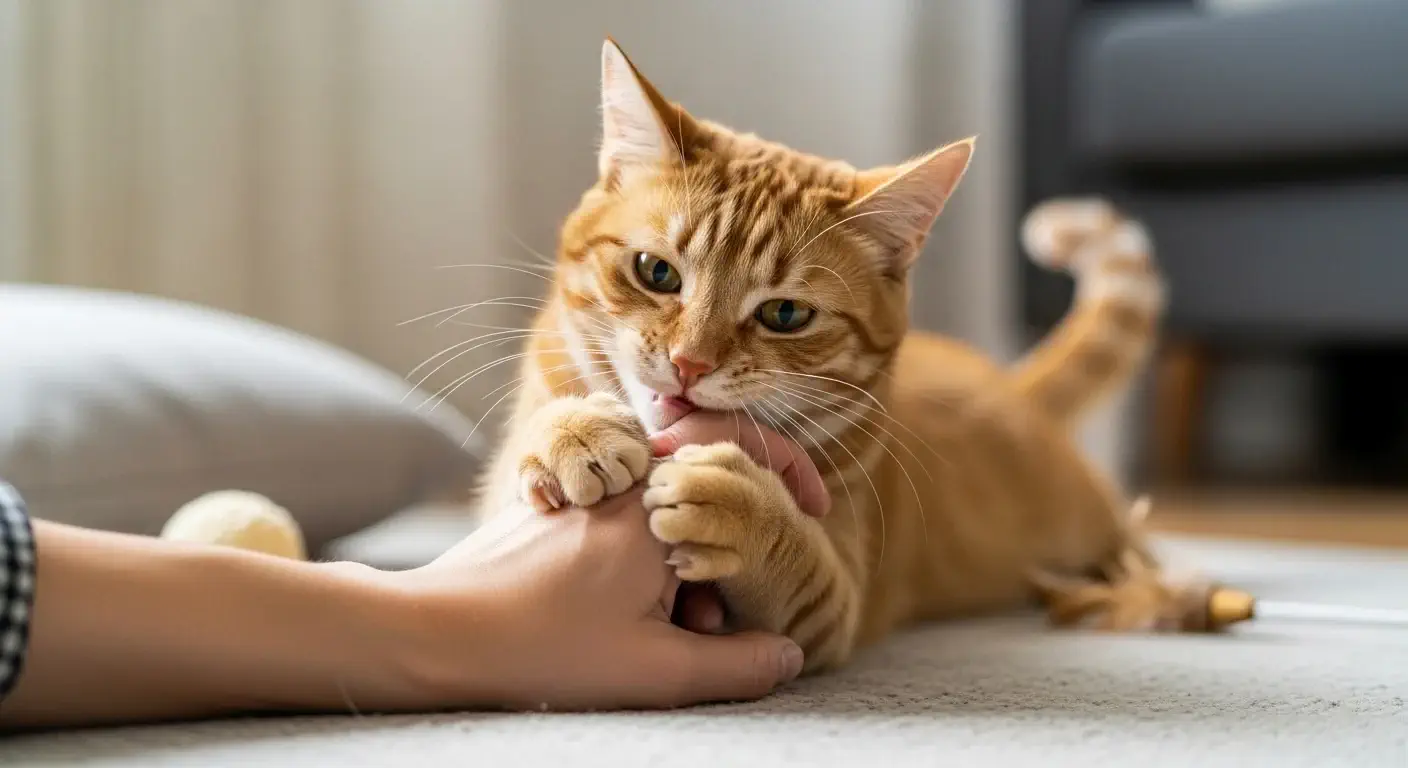
You’re just sitting on the couch, minding your own business. Then out of nowhere, your cat launches at your hand like a tiny, fluffy ninja.
They grab it. They bite it. They start bunny-kicking it like it owes them money.
And you’re sitting there thinking… did I just get attacked by my own pet?
Don’t worry. You’re not alone. This happens in millions of American homes every single day.
Here’s the thing: what looks like an ambush is actually pretty normal cat behavior. Most cats play fight with their humans. It’s part of who they are. But it can be confusing, especially when you’re not sure if your cat is playing… or genuinely plotting your downfall.
The good news? There’s a difference. And once you know the signs, it all starts to make a lot more sense.
In this post, we’re breaking down everything you need to know. Why cats play fight with you, what their body language is really saying, how to tell play from aggression, and how to keep things fun without turning your hands into chew toys.
Do Cats Like Play Fighting With Humans?
Short answer: Yes, many cats absolutely love it.
But here’s the thing. When your cat “play fights” with you, they’re not just goofing around. They’re tapping into something way deeper. We’re talking about hardwired hunting instincts that go back thousands of years.
Cats are natural-born predators. Even your sweet, pampered indoor kitty who eats fancy food from a ceramic bowl still has that wild side tucked inside. Play fighting is basically practice mode for hunting. The pouncing, the grabbing, the biting. It’s all part of the same instinct package.
And guess what? You just happen to be the most available “prey” in the house.
Your cat doesn’t see you as an enemy. They actually see you as an oversized, slightly clumsy playmate. In their mind, that wiggling hand or those moving feet? Perfect target.
That said, not every cat plays the same way. Personality plays a huge role. Some cats are total play-fighters who go hard every evening. Others are more laid-back and prefer a gentle swat here and there.
Age matters too. Kittens are usually the most intense. They play fight constantly because that’s how they develop coordination and learn social boundaries. Adult cats tend to be a little more chill, but many still love a good wrestle session.
Breed can also factor in. High-energy breeds like Bengals or Abyssinians tend to be much more playful and scrappy compared to, say, a relaxed Ragdoll.
The bottom line? Play fighting with humans is completely natural for cats. It’s actually a sign that your cat feels comfortable and safe with you. They wouldn’t play fight with just anyone.
Why Does My Cat Play Fight With Me?
Your cat play fights with you for a few key reasons. And honestly, most of them are pretty wholesome.
Let’s break it down.
1. Hunting Instinct (They’re in Practice Mode)
Cats are wired to hunt. Even if the only “prey” in your home is a crinkle ball or your unsuspecting ankle, that instinct doesn’t just switch off.
When your cat stalks your hand and pounces on it, they’re rehearsing. Crouching, targeting, attacking. It’s the same sequence they’d use to catch a mouse in the wild. Your hand just happened to be in the wrong place at the right time.
2. Boredom and Excess Energy
This one’s huge, especially for indoor cats.
Indoor cats don’t get to roam, hunt, or explore like their outdoor cousins. So all that built-up energy has to go somewhere. If you haven’t given them enough outlets during the day, guess what becomes the evening entertainment? You.
A lot of American cat owners notice their cats go into full attack mode right around 8 or 9 PM. There’s actually a name for this. It’s called the “zoomies” or the “witching hour.” Your cat is basically running a late-night energy burn.
3. Bonding and Attention-Seeking
Here’s the part that might actually melt your heart a little.
Sometimes your cat play fights with you because they want to be close to you. It’s their way of saying “hey, pay attention to me.” Cats aren’t always cuddly. Some show affection through play instead of snuggling.
Think about it like a kid poking their sibling just to get a reaction. Annoying? A little. But also kind of sweet.
Kittens vs Adult Cats
Kittens play fight almost constantly. It’s how they learn bite inhibition, coordination, and how to interact with others. It’s completely normal and actually important for their development.
Adult cats are usually more selective. If your grown cat still play fights with you regularly, take it as a compliment. They trust you enough to let their guard down and get a little wild.
Your cat isn’t being mean. They’re choosing you as their favorite sparring partner. And in cat terms? That’s basically an honor.
How Cats Play With Humans
Cats have a very specific playbook when it comes to playing with humans. And once you recognize the moves, you’ll start seeing it all differently.
The Classic Moves You’ve Probably Already Seen
Pouncing: Your cat crouches low, wiggles their butt, and then launches at your hand or foot like a tiny lion taking down a gazelle. This is pure hunting simulation. It looks dramatic but it’s completely normal.
Biting: Play biting is usually soft and controlled. Your cat isn’t trying to hurt you. They’re mimicking the “killing bite” they’d use on prey. The key difference is pressure. Play bites are gentle. You feel it but it doesn’t break skin.
Bunny Kicking: This is when your cat grabs your hand with their front paws and goes absolutely wild with their back legs. It looks intense. It kind of is. But it’s a classic play behavior, not aggression.
Stalking and Ambushing: You walk down the hallway. Your cat hides behind the couch corner. You pass by and suddenly there’s a paw on your ankle. Congratulations. You just got ambushed. Classic cat move.
Why Hands and Feet Are Always the Target
Moving hands and feet trigger your cat’s prey drive almost instantly. The quick, unpredictable movement mimics how small animals move in the wild. Your cat literally can’t help themselves.
This is also why you should think twice before wiggling your fingers at a playful cat. You’re basically waving a snack in front of them and expecting restraint.
Body Language During Play
During play, your cat’s body stays relatively loose and relaxed. Their eyes are bright and focused. Their tail might flick with excitement. They may pause between attacks, almost like they’re giving you a chance to “escape” before going in again.
That pause? That’s actually your cat being a fair and generous opponent. Respect it.
Cat Play Fighting vs Real Fighting
This is the big one. Knowing the difference between play fighting and real aggression could save you from a nasty scratch, or worse, misreading your cat completely.
The good news is that cats give off pretty clear signals. You just have to know what to look for.
Quick Comparison: Play Fighting vs Real Aggression
| Play Fighting | Real Aggression | |
|---|---|---|
| Body posture | Loose, relaxed, wiggly | Stiff, tense, low to ground |
| Eyes | Bright, curious, dilated | Narrowed or wide with fear |
| Ears | Forward or slightly sideways | Flat back against head |
| Biting | Soft, controlled, no broken skin | Hard, deliberate, may break skin |
| Claws | Mostly retracted | Fully extended |
| Sounds | Quiet or light chirping | Hissing, growling, yowling |
| Tail | Playful flicking or wagging | Puffed up or tucked low |
| Pausing | Stops frequently, resets | Doesn’t stop, keeps escalating |
Breaking It Down Further
Play fighting looks loose and bouncy. Your cat might roll around, chase their own tail between attacks, or run away and come back for more. There’s a lighthearted energy to it.
Real aggression feels completely different. The room almost gets tense. Your cat’s body goes rigid. Their fur might puff up along their spine. And that low, rumbling growl? That’s not playfulness. That’s a warning.
Watch for Escalation Signals
Sometimes play becomes aggression. It doesn’t happen often, but it does happen. Here’s what escalation looks like:
- Bites start getting harder
- Claws come fully out
- Your cat stops pausing between attacks
- Hissing or growling starts mid-play
- Their tail puffs up suddenly
If you notice any of these signs, stop the play session immediately. Don’t yell or punish. Just calmly withdraw your attention and give your cat space to cool down.
One Action Isn’t Enough to Judge
Here’s something really important. Don’t judge your cat’s intent based on a single move. A bite alone doesn’t mean aggression. A scratch alone doesn’t mean aggression.
Look at the whole picture. Body posture, sounds, eye shape, tail position. All of it together tells the real story.
Think of it like reading someone’s mood. One raised eyebrow doesn’t tell you much. But crossed arms, a tight jaw, and zero eye contact? Yeah, that person’s annoyed.
Same idea with cats. Read the full body language, not just one signal.
Signs Your Cat Is Playing, Not Attacking
Wondering if your cat is playing or genuinely coming for you? Here are the clearest signs that your cat is in full play mode, not attack mode.
Key Signs Your Cat Is Just Playing
1. Claws Are Mostly Retracted: A playing cat keeps their claws pulled in most of the time. You might feel a little scratch here and there, but it’s usually accidental. If those claws are fully out and deliberate? That’s a different story.
2. Biting Is Gentle and Controlled: Play bites are soft. They might feel a little pinchy but they don’t break the skin. This is called bite inhibition, and it’s something cats learn from their littermates as kittens. A cat that’s truly playing knows how much pressure is “too much.”
3. Their Body Stays Relaxed and Wiggly: No stiff posture. No puffed-up fur. Just a loose, bouncy, almost goofy energy. If your cat looks like they’re having the time of their life, they probably are.
4. They Keep Coming Back for More: After a play bout, a playing cat will back off, reset, and then come right back at you. That little retreat and return pattern is classic play behavior. An aggressive cat doesn’t give you that reset moment.
5. Tail Is Flicking, Not Puffed: A playfully excited tail flicks back and forth quickly or wraps loosely. A puffed-up, bristled tail means your cat is genuinely scared or angry. Big difference.
6. No Hissing or Growling: Playing cats are usually pretty quiet. Maybe a little chirp or excited chatter. But if you’re hearing hissing, growling, or yowling mid-play, the mood has shifted and it’s time to stop.
7. They Show Self-Control: This is honestly one of the biggest clues. A cat that’s playing pulls back when you react. They notice your response and adjust. An aggressive cat doesn’t care about your reaction at all. They’re laser-focused on the threat they perceive.
Context Always Matters
Was your cat napping peacefully and then you startled them? That changes things. Were they watching birds outside and getting worked up before turning to you? Also changes things.
A cat in a calm, safe environment who initiates the interaction is almost always playing. Read the situation, not just the moment.
Why Do Cats Bite During Play?
Cats bite during play because it’s completely natural. It’s not personal. It’s instinct.
Remember, your cat is a predator at heart. Biting is literally part of their hunting sequence. Stalk, pounce, grab, bite. That’s the full package. When your cat bites your hand during play, they’re just completing the cycle their instincts are pushing them toward.
Bite Inhibition: The Self-Control Skill
Kittens learn something called bite inhibition when they’re young. It basically means learning how hard is too hard.
When kittens play fight with their littermates, they figure out pretty quickly that biting too hard ends the fun. The other kitten yelps and walks away. Game over. So they learn to dial it back.
Kittens that were separated from their litter too early sometimes miss this lesson. That’s why they can grow into cats that bite harder than they realize. According to the American Society for the Prevention of Cruelty to Animals (ASPCA), early socialization plays a huge role in how cats learn to control their bite pressure.
Overstimulation Is a Real Thing
Sometimes a cat starts playing nicely and then suddenly bites harder out of nowhere. This is often overstimulation.
Your cat basically hits a sensory overload point and reacts. It happens fast and can catch you completely off guard. Watch for the warning signs right before it happens: skin twitching, tail lashing, ears rotating back.
Playful Nibble vs Warning Bite
A playful nibble is quick, soft, and your cat moves on immediately. A warning bite is firm, deliberate, and usually comes with a freeze or a hard stare right after.
If you get a warning bite, your cat is done playing. Respect that and back off.
Should You Let Your Cat Play Fight With Your Hands?
Honest answer? It’s super common, but it’s probably not the best habit to encourage.
Look, almost every cat owner has done it. You wiggle your fingers at your kitten, they go crazy for it, and it’s adorable. We get it. But here’s why it can become a problem down the road.
The Risks of Using Your Hands as Toys
It teaches your cat that hands are targets. Once your cat learns that hands equal playtime, they’ll treat every hand that comes near them as fair game. Your hand, your kid’s hand, your visiting grandmother’s hand. You see the problem.
It blurs boundaries. Cats are creatures of habit and pattern. If biting and scratching hands is okay during play, your cat genuinely struggles to understand why it’s suddenly not okay at other times. Consistency matters a lot with cats.
It can escalate as they grow. A tiny kitten nibbling your finger is cute. A fully grown cat clamping down hard on your hand? Not so cute. Habits formed in kittenhood tend to stick around.
When It Might Be Okay
If your cat is very gentle, has great bite inhibition, and has never shown any aggressive tendencies, occasional hand play probably won’t cause major issues. Some cats are just naturally soft players their whole lives.
Just keep a close eye on how the habit develops over time.
When You Should Definitely Avoid It
- If you have young children at home
- If your cat already has aggressive tendencies
- If your cat regularly breaks skin during play
- If guests or strangers interact with your cat often
In these situations, redirecting to toys immediately is the smarter and safer move. Your hands will thank you later.
The Bottom Line
Using your hands as toys is one of those things that feels harmless in the moment but can create real headaches later. Better to build good habits early than undo bad ones down the line.
Is It Okay to Play Fight With Your Cat?
Yes, absolutely. Play fighting with your cat is perfectly fine. You just need to do it the right way.
Play is genuinely important for your cat’s physical and mental health. It keeps them active, reduces stress, and strengthens the bond between you two. According to a study published in the journal Applied Animal Behaviour Science, cats that engage in regular interactive play with their owners show lower levels of stress-related behaviors. That’s a pretty solid reason to keep the play sessions going.
The key word here is structured.
Structured Play vs Rough Play
Structured play means you’re in control of how the session goes. You choose the toy. You set the pace. You decide when it ends. Your cat gets all the fun and excitement of hunting and pouncing without your hands becoming casualties.
Rough play, on the other hand, is chaotic and boundary-free. It usually involves hands, feet, and zero clear rules. That’s where problems start creeping in.
Boundaries Make Play Better
Setting boundaries doesn’t make playtime less fun. It actually makes it more sustainable. Your cat learns what’s acceptable. You stay scratch-free. Everybody wins.
Think of it like playing tag with a kid. Fun and wild, yes. But there are still basic rules that keep everyone safe and happy.
Keep the Tone Reassuring
You don’t need to feel guilty about playing with your cat. You’re not doing anything wrong by engaging with them. Just be intentional about how you do it.
Play with purpose. Use the right tools. And enjoy every single ridiculous second of it.
Safe Ways to Play Fight With Your Cat
Want all the fun of play fighting without the scratches and bad habits? Here’s how to do it right.
The secret is simple. Replace your hands with toys. Give your cat something appropriate to stalk, pounce on, and bite. They get the same instinct satisfaction. You keep your skin intact.
The Best Toys for Play Fighting
Wand Toys and Feather Teasers These are honestly the gold standard for interactive cat play. You control the movement from a safe distance. Your cat gets to stalk, leap, and pounce like the tiny predator they are. Brands like Da Bird and SmartyKat are hugely popular with American cat owners and for good reason. They mimic real prey movement incredibly well.
Interactive Puzzle Toys These keep your cat mentally stimulated between play sessions. A mentally tired cat is a calmer cat. Less likely to ambush your ankles at midnight.
Stuffed Animal Kicker Toys Perfect for satisfying that bunny kick instinct. Your cat can grab, wrestle, and go absolutely wild without your arm being involved at all. Look for ones filled with catnip for extra excitement.
Laser Pointers Great for getting your cat moving fast. Just make sure you always end a laser session by landing the “dot” on a physical toy. Otherwise your cat never gets the satisfaction of actually catching their prey and that can cause frustration.
Create a Simple Play Routine
Cats actually thrive on routine. Try building a short daily play schedule:
- Pick a consistent time, ideally evening when energy is naturally higher
- Choose one or two toys to rotate through
- Play actively for 10 to 15 minutes
- Wind the session down gradually, slow the toy movements
- End with a small treat or meal to complete the hunt cycle
That last step is important. In the wild, hunting ends with eating. Mimicking that sequence helps your cat feel genuinely satisfied instead of still wound up after playtime.
How to Redirect Mid-Play
If your cat grabs your hand during a play session, don’t yank it away fast. Quick movements trigger more excitement. Instead, go limp and still for a second, then calmly swap your hand out for a toy.
Consistency here is everything. Every time hands get grabbed, redirect to a toy. Your cat will learn the pattern faster than you think.
How to Set Boundaries During Play
Setting boundaries with your cat during play isn’t mean. It’s actually one of the kindest things you can do for them.
Cats feel more secure when they understand the rules. Clear boundaries mean less confusion, less accidental aggression, and a much more enjoyable relationship for both of you.
How to Actually Set Boundaries
Stop play the moment biting gets too hard. The second your cat bites harder than is comfortable, the play session ends. No exceptions. Don’t push through it. Don’t laugh it off. Just stop.
Calmly stand up, cross your arms, and withdraw your attention completely. No eye contact, no talking, no reaction. This communicates clearly that hard biting equals end of fun.
Use a consistent verbal cue. Pick a short, firm word like “ouch” or “no” and use it every single time biting crosses the line. Say it calmly, not angrily. Over time your cat genuinely starts connecting that word with the idea that they’ve gone too far.
Never reward rough behavior. If your cat bites hard and you keep playing anyway, you’ve just taught them that biting hard keeps the game going. Consistency is everything here. One mixed signal can undo a week of good habits.
Positive Reinforcement Works Wonders
Reward the behavior you actually want. When your cat plays gently and uses the toy instead of your hand, give them praise, a treat, or extra playtime. Cats respond really well to positive reinforcement.
According to animal behaviorists, reward-based training is far more effective with cats than punishment. You’re not trying to discipline your cat. You’re guiding them toward better habits by making good choices feel worth their while.
Be Patient and Stay Consistent
Boundary setting takes time. Don’t expect overnight results. But if you stay consistent, most cats pick it up within a few weeks.
Your cat wants to play with you. They just need to learn the house rules first.
Common Mistakes Cat Owners Make During Play
Most cat owners make these mistakes without even realizing it. Don’t worry though. Knowing about them is literally half the battle.
1. Using Hands and Feet as Toys
We’ve talked about this one but it’s worth repeating because it’s the most common mistake by far.
It starts innocently. You wiggle your fingers at a tiny kitten and they go bananas for it. Adorable. But fast forward six months and now you have a cat that treats every hand in the house like a chew toy. Not so adorable anymore.
Always use actual toys. Every single time.
2. Encouraging Rough Play in Kittens
Kittens are small and their bites barely hurt so rough play feels harmless. A lot of owners actually laugh and egg them on during intense play sessions.
But here’s the thing. You are literally training your kitten right now. Every interaction is teaching them what’s acceptable. Encouraging roughness in kittenhood almost always creates a rougher adult cat.
3. Ignoring Warning Signs
Your cat gives signals before they escalate. Tail lashing. Skin twitching. Ears rotating back. Pupils dilating.
A lot of owners miss these signs completely and then act surprised when a play session turns into a scratch fest. Start paying attention to the warning signals and you’ll be able to stop things before they go sideways.
4. Not Providing Enough Daily Stimulation
This is a big one for indoor cats especially.
If your cat isn’t getting enough playtime and mental stimulation throughout the day, all that pent-up energy has to go somewhere. Usually it goes into your ankles at 11 PM.
Aim for at least two dedicated play sessions daily. Even 10 minutes each makes a noticeable difference in your cat’s overall behavior and mood.
5. Punishing Your Cat for Normal Play Behavior
Yelling at your cat, spraying them with water, or pushing them away roughly during play doesn’t teach them anything useful. It just confuses and stresses them out.
Remember, play fighting is natural for cats. The goal is to redirect and guide, not punish.
Keep it light, stay consistent, and give your cat the chance to learn the right way.
Conclusion
So, do cats like play fighting with humans? Absolutely. And now you know exactly why.
Play fighting is natural, instinct-driven, and honestly one of the ways your cat shows they feel safe and comfortable around you. It’s not aggression. It’s not bad behavior. It’s just your cat being a cat.
The key is understanding what’s actually happening. When you can read your cat’s body language, recognize the signs of play versus real aggression, and set up healthy boundaries, play fighting goes from confusing to genuinely fun.
Your hands are not chew toys. Wand toys exist for a reason. Consistency is your best friend. And a good play routine can completely transform your cat’s behavior and your bond with them.
At the end of the day, when your cat launches off the couch and grabs your ankle on your way to the kitchen, they’re not declaring war on you.
They’re inviting you into their tiny, dramatic, absolutely chaotic jungle game.
And honestly? That’s kind of an honor.
So grab a feather wand, clear some floor space, and enjoy every ridiculous second of it. Your cat picked you as their favorite opponent. That’s love in its most feral, slightly unhinged form.
Frequently Asked Questions (FAQs)
1. Do cats enjoy play fighting with their owners?
Yes, most cats genuinely enjoy play fighting with their owners. It satisfies their natural hunting instincts and gives them a chance to bond with you. Cats that play fight with their humans are usually comfortable, stimulated, and happy. It’s actually a positive sign of a healthy relationship between you and your cat.
2. How do I know if my cat is play fighting or being aggressive?
Look at the full picture, not just one action. A playing cat has a relaxed body, soft bites, retracted claws, and pauses between attacks. An aggressive cat shows stiff posture, flattened ears, fully extended claws, hissing or growling, and doesn’t stop or reset. Context matters too. If your cat initiated the interaction calmly, it’s almost always play.
3. Is it bad to let your cat play fight with your hands?
It’s not dangerous in the short term but it’s not a great habit to encourage. Using hands as toys teaches your cat that biting and scratching hands is acceptable. This can become a real problem as your cat grows, especially if children or guests are around. Redirecting to wand toys and kicker toys is always the smarter move.
4. What does it mean when a cat play fights with you?
It means your cat trusts you, feels safe with you, and wants to interact with you. Play fighting is how cats practice their hunting skills and burn energy. When your cat chooses you as their play partner, it’s genuinely a sign of affection and comfort. You’re basically their favorite sparring partner and that’s a good thing.
5. Why does my cat suddenly bite me hard during play?
Sudden hard biting during play is usually a sign of overstimulation. Your cat hits a sensory overload point and reacts instinctively. Watch for warning signals right before it happens like tail lashing, skin twitching, and ears rotating backward. When you spot those signs, slow down or stop the play session before it escalates.
6. How often should I play with my cat?
Aim for at least two play sessions daily, around 10 to 15 minutes each. Morning and evening sessions work great for most cats. Evening play especially helps burn off that natural spike in energy cats get at night. Regular daily play reduces unwanted behaviors, keeps your cat healthy, and strengthens your bond significantly.